
Judy Chicago, Linda Nochlin And The Birth of Feminist Art
Fernando Castro R.

Judy Chicago is credited for coining the term “feminist art.” That was in 1970 when she started the first feminist art program in the United States at the California State University, Fresno. She then moved the program to the California Institute for the Arts, where together with Miriam Schapiro, she organized Womanhouse, the first art exhibition with a female point of view. Womanhouse occurred at the pinnacle of the Women’s Liberation Movement, later renamed “second-wave feminism” (ca. 1960-1990). Indeed, on the first day of the exhibit only women were allowed to see the exhibition. Chicago, Schapiro and twenty-one female students participated in that watershed exhibit.
“Chicago” was not Judy’s original name. She was born Judith Sylvia Cohen; and, by marriage she became Judy Gerowitz. After her husband’s death and her conversion to the feminist cause she decided to change her name to “Judy Chicago” because she was born in that city and spoke with an unmistakable Chicagoan accent. To celebrate her decision, during her 1970 solo show at the California State University at Fullerton she hung a banner that read “Judy Gerowitz hereby divests herself of all names imposed upon her through male social dominance and chooses her own name, Judy Chicago.”
The name change was an easy gesture. However, once she embarked in the path of feminist art, she assumed the difficult responsibility of leaving behind accepted beliefs, thinking art anew, and seeking a feminist revisionist history that had hitherto remained hidden, unwritten, or distorted. As a teacher, she instilled in her students the urgency of undergoing this mental catharsis and conceptual synthesis. It was a period of tumultuous times in the United States: the Vietnam War dissidence, the Psychedelic Revolution, the Sexual Revolution, the Women’s Liberation Movement, etc.
In 1971 feminist art-historian Linda Nochlin published in ArtNews a provocative essay that both challenged and oriented feminist artists and historians: “Why Have There Been No Great Women Artists?” Nochlin claimed that if answered properly the question was important beyond the issue of women artists. It meant to challenge the assumptions of intellectual inquiry in history, the social sciences, and even psychology. Nochlin wrote, “The feminist’s first reaction is to swallow the bait and attempt to answer the question as it is put: to dig up examples of insufficiently appreciated women artists throughout history.” In other words, deny the premise of the question. Nevertheless, as
worthwhile and scholarly as such attempts may be, Nochlin wrote, “they do not really confront the question” and by answering inadequately they “reinforce its negative implications.”
The other approach to the question, argued Nochlin, is to accept a feminist proposal of “the existence of a distinctive and recognizable feminine style, differing in both formal and expressive qualities from that of men artists and posited on the unique character of women’s situation and experience.” Though Nochlin granted the viability of this answer –from which it would follow that some women are great artists albeit by different standards than men –she concluded, “Unfortunately, though this remains within the realm of possibility it has so far not occurred.” However, the way Nochlin framed this second option commits us to a relativism that may be less than salutary and may end up being counter-productive to women’s aspirations. Moreover, it hinged on the very problematic notion of “style.” Nochlin attacked it precisely on the point that there is no common style in the work of renowned female artists; hence, no feminist style. The question to ask about Chicago is whether in fact she conceived her work entertaining the belief that it had to measure up to these alternative feminist standards, or to mainstream standards –as contaminated with male chauvinism as they may be. Or, did Chicago find a middle way out of the conundrum?
One of the conclusions that Nochlin drew in that landmark seminal is antithetical to relativism. She spelled it thus: “The problem lies not so much with the feminists’ concept of what femininity is, but rather with their misconception–shared with the public at large–of what art is: with the naive idea that art is the direct, personal expression of individual emotional experience, a translation of personal life into visual terms. Art is almost never that, great art never is. The making of art involves a self-consistent language of form, more or less dependent upon, or free from, given temporally-defined conventions, schemata or systems of notation, which have to be learned or worked out, either through teaching, apprenticeship or a long period of individual experimentation.”
The second point Nochlin was making in this essay was that excellence in art is not a matter of gender but of the cultural, psychological, socio-economic conditions that make it impossible for great individual artists to exist. She wrote, “But in actuality, as we know, in the arts as in a hundred other areas, things remain stultifying, oppressive and discouraging to all those –women included–who did not have the good fortune to be born white, preferably middle class and above all, male.” One can say, then, that despite the odds, there have indeed been great women artists. Can we ask the female art establishment (so as to avoid male bias) whether “greatness” can be denied to visual artists such as Artemisia Gentileschi, Eva Hesse, Gertrude Goldschmidt, Louise Bourgeois, Shirin Neshat, Marlene Dumas, Leonora Carrington, Cindy Sherman, Sherrie Levine, and Judy Chicago herself?
Following Nochlin’s imperative, one ought to challenge the institutional assumptions of art history; particularly in what prima facie appear to be the quintessentially male notions of “master” and “masterpiece.” “Greatness” itself is a suspect notion linked to these notions. Nochlin herself questions that other favorite of some art historians: genius. She wrote, “Genius, in turn, is thought of as an atemporal and mysterious power somehow embedded in the person of the Great Artist.” Without these suspect notions, art history becomes populated by many kinds of important artists. Unquestionably, Judy Chicago becomes part of that important elite, if only for throwing “The Dinner Party” (1979).
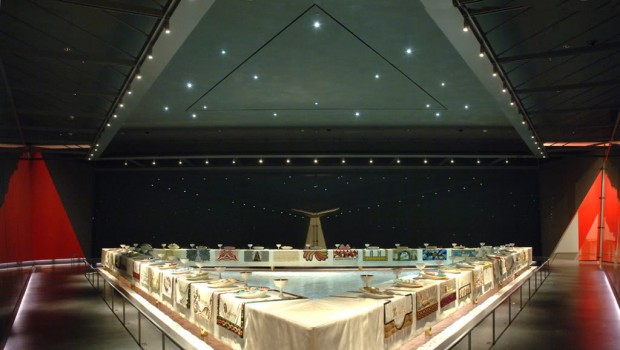
Curiously, forty years later Linda Nochlin was one of the curators of the 2007 Global Feminisms exhibit at the Brooklyn Museum of Art in which Judy Chicago’s “The Dinner Party” was the central piece. New York Times critic, Roberta Smith responded to that exhibit thus: “The combination of the Global Feminisms exhibition at the Brooklyn Museum and its Elizabeth A. Sackler Center for Feminist Art, whose inauguration this show celebrates, is like a false idea wrapped in confusion. The false idea is that there really is such a thing as feminist art, as opposed to art that intentionally or by osmosis reflects or is influenced by feminist thought, of which there is plenty.”
Smith continued, “The center seems to have been created mostly for its publicity value. It isn’t necessary in order to showcase the only jewel in its crown, Judy Chicago’s unruly, inspiring installation ‘The Dinner Party,’ a landmark in feminist history that occupies around 5,000 of the center’s 8,300 square feet. Made by Ms. Chicago and scores of volunteers from 1974 to 1979, this immense piece is in many ways the perfect storm of second-wave feminism and modernism: it is lashed together by pride, fury, radiating labial forms and numerous female-identified crafts, most prominently painted ceramic plates and needlework. Whatever you think about it as a work of art, it amounts to one-stop consciousness-raising and historical immersion: an activist, body-centered tribute to 39 important women. Study ‘The Dinner Party’ close enough and your bra, if you’re wearing one, may spontaneously combust.”
“But,” Roberta Smith added, “Feminism is not a style, or a formal approach. It is a philosophy, an attitude and a political instrument. It is more important than Pop, Minimalism or Conceptual art because it is by its very nature bigger than they are, more far-reaching and life affecting. In addition feminism is not of itself an aesthetic value. It is an idea that can assume an organic force in some artists’ work, but others just pay it lip service without much exertion or passion.”
Notwithstanding Smith’s harsh indictment, Judy Chicago has not recanted. In her website www.judychicago.com, we find: “What is feminist art? It is art that reaches out and affirms women and validates our experience and makes us feel good about ourselves. Feminist art teaches us that the basis of our culture is grounded in a pernicious fallacy –a fallacy which causes us to believe that alienation is the human condition and real human contact is unattainable. This fallacy has divided our feelings from our thoughts, this fallacy has caused the planet to be divided as are the sexes. Feminist art is art that leads us to a future where these opposites can be reconciled and ourselves and the world thereby made whole.”
When all is said and done, Judy Chicago’s The Dinner Party (1979) remains an iconic work of feminism. Philosopher and critic Arthur Danto has called it “one of the major artistic monuments of the second half of the 20th century.” Feminist critic Lucy Lippard stated in 1980, “My own initial experience was strongly emotional… The longer I spent with the piece, the more I became addicted to its intricate detail and hidden meanings, and defended the work as an excellent example of the feminist effort.” On the other hand, British artist Cornelia Parker offered a scathing although somewhat ad hominem commentary in 2010: “Too many vaginas for my liking. I find it all about Judy Chicago’s ego rather than the poor women she’s supposed to be elevating –we’re all reduced to vaginas, which is a bit depressing. It’s almost like the biggest piece of victim art you’ve ever seen.”
Is The Dinner Party to be viewed only as a symbol for second wave feminism, and increasingly out of place in third wave issues? Or, are these feminist “waves” so ill conceived that they prevent us from seeing art works such as Judy Chicago’s in the continuum of female issues? Setting aside the valiant Romanticism of some posturing, one thing is for sure: the legal issues of the first wave, and the de facto inequalities that concerned the feminists of the second wave are not yet fully resolved. In fact they are still issues in the coming presidential elections. As for Judy Chicago, it is clear that her work together with Nochlin’s essay are important challenges to the assumptions of an official art history that is plagued by an ideology that is de facto male, but more generally, European.
Posted: January 11, 2013 at 6:41 pm