

The Mystery of Survival
Alicia Gaspar de Alba

When my mother left me in the Colonia La Gran María, I was ten years old, and I hated men. My stepfather had once told me that women were like the earth, and that men could mine them and take anything they wanted. Girls, he said, especially ones like me who talked backed and disobeyed, had to be dealt with in a special way. I remember that evening like a deep secret I must never tell. My mother had gone to the orphanage with food and some of my old clothes.
“I’m not a woman,” I cried, terrified staring down at the thing sticking out of his pants.
“You’re a bad girl!” he told me, spanking me hard. “Men have to punish bad girls.” He spanked me again and made me take it in my mouth. Later, when my mother came home, he went to the kitchen and told her I could no longer stay in his house.
“He doesn’t love you. We can’t live here anymore,” my mother said as we walked to the plaza. “We’re going away. To la frontera. To my cousin Lucía’s house.”
“Is your cousin Lucía married, Mamá?” I asked.
“She works on the other side. Maybe she can find me a job,” she said. She had not heard my question.
In the plaza, we found an empty bench near the kiosko, and Mamá told me to sit with my back to her so that she could re- braid my hair with the new ribbons she had bought me.
“Why does he do those things to me, Mamá?”
She unwound my hair and combed it out with her fingers. “Remember, hija,” she said at length, “the mystery of survival is obedience. If we can obey even the most terrible thing, we will survive it. If we disobey, we will always lose. Remember that. Obey and you will survive. Disobey and you will suffer.”
“But it hurts me, sometimes, what he does.”
“You think you hurt now, hija,” she said, starting on the second braid. “Later you’ll know that you survived. Later you’ll know what real suffering is.”
I watched the pigeons and the doves that lined the railing of the kiosko. Do birds have to obey? I wondered.
“Come on,” Mamá said after she’d finished fixing my hair. “I’ll buy you an elote. Do you want one?” We walked over to the man who was selling boiled corn on the cob slathered with mayonnaise. My stomach heaved.
“I’d rather have coconut,” I said, and we went to the lady slicing coconut flesh on a cart.
“Everything on it,” I said to the lady, and I watched her squeeze a lime over some slices in a plastic glass, powder them with red chile and sprinkle them with salt. The lady handed me the glass, and Mamá paid her from a little bag she wore between her breasts.
“Have you ever been to la frontera?” I asked as we strolled around the plaza eating coconut. Her eyes were shadowed. She did not want to speak.
We left the next morning. The sun had not risen yet, but women were already out sweeping their sidewalks and talking with the men who picked up the trash. I had to carry my clothes and my schoolbooks in a plastic market bag imprinted with the image of the Virgen de Guadalupe. Mamá lugged an old suitcase. She seemed strangely happy. She was shivering, from the cold, she said, but there was something about her face that I had never seen before. The line between her eyebrows wasn’t pleated; her lips weren’t pressed together as usual. She had parted her hair differently, and for once, I noticed the soft curve of her jawline, undisturbed by the constant flexing and unflexing of her jaw muscles that was her habit.
“You look beautiful, Mamá,” I told her, slipping my free arm around her waist as we walked to the church. She stroked my cheek, then pressed me tightly to her side.
“My cousin Lucía is very nice,” she said. “You’re going to be happy, I know.”
I narrowed my eyes. Was Mamá planning to send me off by myself? Or was she going to leave me with this cousin of hers the way she’d left me with her sister two years ago? Maybe she was coming back to live with him. I turned my head and saw him standing by the open window, tucking his shirt into his open pants.
“Will you stay with me?” I asked, keeping my voice low so that she wouldn’t hear the fear in it.
“I am with you, hija. I will always be with you, no matter how far apart we are.”
I could smell the starch in her dress and saw that she had worn her new shoes, the ones that she said hurt her when she walked. The market bag felt suddenly too heavy for me. I turned my face toward her body and cried into the dark cloth of her dress. The bells of Santa Clara tolled for the five-thirty Mass, and Mamá turned onto the street that led to the church, digging her mantilla out of her purse.
“Wait for me here,” she said outside the entrance, leaving her suitcase beside me. I watched her go down the aisle, genuflect in front of the altar and turn left where the larger picture of the Virgen of Guadalupe hung in its golden frame. She lit a long candle and then knelt and made the triple sign of the cross over her face, heart and shoulders. The smell of incense and wax filtered out to me.
“It’s bad luck to stand in the doorway of a church,” said Don Anastacio, our next-door neighbor, who always attended early Mass before opening his shoe repair shop on the plaza. “What are you doing here so early, anyway?”
I didn’t answer, just moved over to let him pass and decided to wait for Mamá further down the steps. Before leaving the churchyard, we stopped at the fountain where Mamá tossed an American coin into the water. She bought me five bags of pumpkin seeds from a man with no legs and told me to save them for the trip.
“We have to hurry,” she said. “We still don’t have our tickets.”
She was going with me. I felt my stomach unclench. She hailed a taxi and haggled with him for a good price to the train station.
In the pink and gold of the sunrise, the town looked different to me. I had never realized how beautiful Querétaro was in the spring. The flowering jacaranda trees along Los Arcos were nearly as high as the arches of the aqueduct, casting a lavender glow on the thoroughfare all the way to the center of town and filling the streets with purple petals. The different-colored houses with potted geraniums on their balconies. The bells of all the churches ringing for morning Mass. The bright skirts of the Otomí women selling their embroidered cloths and blouses outside the train station. Inside the station, two boys wanted to carry our things. Mamá gave them each a bag of pumpkin seeds, and they ran off.
“Stay close to me,” Mamá said as we stood in line to get our tickets to Ciudad Juárez.
Our train pulled out of Querétaro just as the big smelter sounded the morning horn. My stepfather would be leaving the house with his hard hat and the lonchera Mamá had prepared for him last night. Yesterday at this hour, Mamá was listening to the radio as she finished ironing my uniform. I was eating my breakfast and trying to memorize the paragraph on snakes in my biology book that I had to recite today at school. She told me not to tell anybody, not my teachers or my friends, that we were leaving.
Sitting on the cracked black seat of the moving train, I knew that I would never come back here. I would never go to that school again or wear that uniform. I understood then that the same thing that happened to snakes could happen to people.
Just outside the city limits of Querétaro, the train passed a long, whitewashed wall painted with the election messages of the PRI and PAN, and beside them, a proverb in green spray-painted letters that spelled out: El PUEBLO QUE PIERDE SU MEMORIA PIERDE SU DESTINO.
I asked Mamá what it meant.
“I don’t know,” she said, staring straight ahead and clutching her rosary beads as the train lurched. “Mexican proverbs don’t mean anything anymore.”
I looked out the window and tried to memorize the shape of the Cerro de las Campanas, the Hill of Bells, where a bronze Benito Juárez stood twenty meters into the sky. The same hill where Maximilian had one faced the firing squad on cinco de mayo. Did they have Cinco de Mayo parades in Ciudad Juárez, I wondered. The rocking of the train lulled me to sleep almost immediately. We were sitting in second class, and the stench of the toilets was turning my stomach, so Mamá covered my face with her rebozo and told me to go to sleep.
“Be grateful we’re not in third class,” Mama said.
“¿Hasta dónde van?” the lady across the aisle from us asked. “A la frontera,” Mamá said. “Ciudad Juárez.”
“¡Híjole, se les va a hacer bien largo!” said the lady. “But at least it’s not as far as Tijuana. I went from DF to Tijuana, once, and I wanted to throw myself from the train halfway through.” The lady laughed loud.
Mamá sighed and turned her face to the window. She did not want to talk anymore.
“The worst part is these trains are putrid, todos podridos, especially back here,” the lady continued. “Just pray we don’t get any passengers with pigs and goats.”
“How long is it going to take us?” I mumbled under Mamá’s rebozo.
“Duérmete,” Mamá said, stroking my hair with her long nails until I fell asleep. When I opened my eyes hours later, the train was pulling into another station. The chatty lady was gone.
“¿Ya llegamos?” I asked, rubbing the sleep out of my eyes. “We’re just in Aguascalientes,” Mamá said. “I hope you’re not going to keep asking me that at every stop.” She waved her hand in front of her to indicate how far down the line we still needed to go. “Faltan dos días, todavía. Here, have a torta before it goes bad. I saved you some of my tamarindo soda.”
Two days to go? I thought. Maybe that’s why that lady said she had wanted to throw herself from the train. Maybe I did, too. I ate my huevo con chorizo torta that Mamá had made for the trip and took small sips of her flat soda, staring out the window at the names of the stations we passed: Zacatecas, Gómez Palacio, Parral, Camargo, Delicias—each one drier and uglier than the last. People of all ages climbed on and off with their roped boxes and cages of chickens and coolers full of sodas and food to sell—burritos, tacos and quesadillas. By the time we reached the Chihuahua station, two days later, we had to wait almost five hours for the train’s toilets to get repaired.
Nearly three days and three nights after we left Querétaro, we finally stepped down onto the smelly platform of the train station in Ciudad Juárez. My belly felt swollen and queasy, and we were instantly swallowed into a bustling crowd. Mamá held my hand tightly as she tried to maneuver us and our bags through that river of bodies. Some of them did not smell so good. Or maybe it was just me that stunk after three days of not washing or changing my underwear.
Finally, outside, a taxi driver offered to carry our bags, and Mamá told him the name of the colonia we were going to. The man shook his head and told us that taxis didn’t go into the colonias. Too dangerous, he said, dropping our bags at our feet. No paved streets. For that, we would have to take a rutera, and he pointed to a white van that was just leaving the station.
“Take the one that says ‘colonias,’” the man called behind us as we stepped out. “And don’t take your eyes off your bags. There’s always maleantes on those things looking for easy prey.” The rutera stuffed what looked like twenty of us inside, even though the sign painted on the door said there was room for only fifteen passengers. I looked out the grimy mud and bird-shit splattered window and tried to breathe. Mamá did not tell me we were coming to a place as ugly as this, where there were beggars on every corner and more trash than trees. The rutera zigzagged through long lines of traffic and crossed the railroad tracks just before a cargo train whistled by.
Mamá asked the woman bending over her if the driver was crazy.
“They don’t care,” the woman said. “They’re human beasts.
¿De a dónde vienen? Are you from the south?” “
“From Querétaro,” Mamá said. “My daughter and I are looking for the Colonia La Gran María.”
“La Gran María?” the woman repeated, shaking her head. “Never heard of it. Does anybody know where this Colonia Gran María is?” she asked everyone in the vehicle.
“That’s the last stop,” the driver said over his shoulder.
The woman made a strange face, pulling her mouth down and her head back, eyes rolling like she had just heard some bad news.
The rutera stopped suddenly behind a bus, and the woman and a few other passengers squeezed out. Ahead of us I could see grey barren mountains and dirt roads instead of streets. The whole place made me feel so sad.
“I don’t like it here,” I told Mamá.
“You didn’t like it at home, either,” she said.
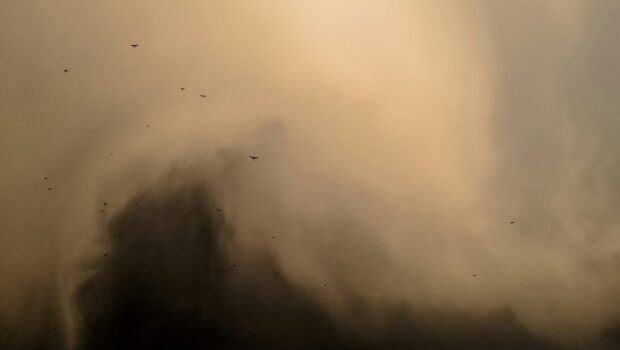
I gazed out the window again at the whirls of dust, the flat adobe houses caked with crumbling paint, the barefoot babies wandering in piles of trash. No parks, no plazas, no jacarandas anywhere. This had to be the ugliest place in the world. I squeezed my eyes shut to keep the tears from flowing.
We were the last ones in the rutera, and I noticed that the driver was slowing down, that the dirt roads cast off a sandy haze that made it difficult to see out the window, that the houses were now made of sticks and cardboard and corrugated tin. I looked up at Mamá, our eyes meeting, holding, letting go.
“Última parada, La Gran María!” the driver barked as though he were conducting a train, and we had barley lifted Mamá’s suitcase from the van before the rutera jerked into reverse and disappeared behind a cloud of black fumes.
“It’s a miracle we’re not dead,” Mamá said, smoothing the wrinkles from the back of her dress. “Look at your face! It’s all smeared.” She opened her purse and rummaged through it. Behind her, the tin shacks of the Colonia La Gran María reflected rusty sunlight.
A group of kids that had been playing kick the can in the road came up and watched us.
Mamá took out her handkerchief, wet a tip of it with her tongue, and started cleaning my face. A rat ran out of the Abarrotes store, chased by a woman with a broom.
“This is the ugliest place I’ve ever seen,” I said.
“Ugly is in your soul,” Mamá said. “If your soul is clean, ugliness can’t touch you.”
“Then why are you taking so long to turn around?” I sassed.
She slapped me, then continued wiping my face. “What kind of manners are those?”
The kids laughed.
“Besides, this is only temporary. When I get a job, we’ll…” She put the handkerchief away and turned around to face the place where she had brought me. She drew her breath. “When I get a job, we’ll move,” she said.
I picked up the market bag and walked off, turning my back on her.
“Where are you going?” she called behind me. “You don’t even know where you’re going.”
Neither do you, I wanted to yell at her, pressing the tears out of my eyes with the heel of my free hand. Past the last row of shacks, I spotted a couple of willow trees growing along the bank of a narrow brown river. Two wide highways, separated by a stretch of desert, shimmered on the other side of the river. Beyond the highways, on a landscape hill, stood a clump of tall, white buildings with red brick roofs and a parking lot gleaming with rows of cars.
“There she is!” Mamá cried behind me, and then, louder “Lucía! We’re over here!”
Mamá dropped her suitcase and waited for the other woman to reach us, her plump arms swinging from side to side. Taller and younger than Mamá, with short black hair and light-colored eyes, she opened her arms and hugged my mother tightly.
“Acércate,” Mamá called me, waving me over with one arm while she kept her other arm around her cousin’s shoulder. I sucked my cheeks in and came closer, and the woman named Lucía bent down to study my face. Her large, owl-like eyes seemed to change from light brown to yellow right in front of me.
“At last, I meet my only niece,” she said, holding out her hand.
I shook it, but it felt more like having my hand swallowed, like a big fish gulping down a little fish.
“Are you hungry?” she asked.
I looked at Mamá and Mamá nodded. “No,” I said. “I’m thirsty.”
“Who isn’t?” Lucía said, standing up again and reaching for my market bag. “Everything is thirsty in the desert.” She took Mamá’s suitcase as well.
“She’s being a Mrs. Contreras right now,” Mamá told Lucía. “If I say good, she’ll say bad. If I say food, she’ll say water.”
I stayed behind them as we walked in the direction of one of the shacks. It was made of mismatched planks of lumber and had a corrugated tin roof and a striped sarape hanging in the doorway. Suddenly, a white dog bounded out from behind a heap of old tires. Mamá screamed. Lucía whistled sharply, and the dog slowed down.
“This is Sancho,” Lucía said when the dog was beside me, sniffing my knees. “Don’t be afraid of him. He’s a good friend.” I had never touched a white dog, and his fur felt strangely soft, strangely clean in this dusty place. He stood there patiently while I petted his back and scratched between his pink-tipped ears.
“Don’t worry,” Lucía told Mamá as they moved on, “my father whipped all the wildness out of him.
Her father? I thought. Does Mamá’s cousin Lucía have a man in her house? The mask of my stepfather’s face fell over the dog’s head. Eyes bloodshot. Teeth bared. You’re a bad girl! Men have to punish bad girls. Get the devil out of them. Clean the devil out with this. Swallow it! Swallow it!
Sharp needles were pushing into my head. My mouth tasted of vomit. Faraway, I heard my mother’s voice.
“She hardly ate anything on the train,” she was saying.
I heard swishing water, then something sticky and wet covered my forehead. It smelled of melon.
“She’s waking up,” said another voice, closer. My eyes cracked open.
“Also, maybe it was the heat.” Mamá sounded old.
I heard the squeaking of bedsprings, and then I was helped to sit up, my head resting on an unknown hand. The wet thing on my forehead fell off me, and I saw that it was a cantaloupe rind.
“Drink this, hija.”
Hot liquid touched my lips. The smell of chicken broth woke me completely. I was lying on a box spring in a room with no windows, the afternoon light arrowing in through the cracks in the walls. A cot with a thin mattress and a pillow stood in the corner. Two crates pushed up against a table served as chairs. On an- other crate, an altar had been assembled, crowded with framed pictures of saints, including a soldier saint I had never seen, lit- tle statues of la Virgen, San Martin de Porres and San Judas, votive candles, a jar of dark liquid and a tin cup with feathers in it. The glow of the candles flickered on the dirt floor.
I was gulping the broth down more quickly than Mamá could spoon it out of the bowl, and Lucía told me that I was going to make myself sick again if I ate so fast.
“I’m hungry,” I told her, remembering suddenly that she had a man in her house, a man who probably slept in that cot over there in this one-room hovel.
I pulled away from Lucía and told Mamá that I didn’t want to stay here, that I was afraid of that man in this house, that he would do what the other man had done.
Mamá stopped feeding me, her face slowly darkening to a deep red. “Can you give us a moment?” she said to her cousin, gesturing with her head that she wanted her to leave the room.
Quietly, Lucía left, taking the half-finished bowl of soup with her. When she had gone, and the sarape flapped over the doorway again, Mamá turned to me and slapped me hard.
“You must never talk about that!” she hissed. “If you do, La Llorona will come to you. She’ll drag you to the river and drown you.”
I bent my head to one side, eyes narrowed. “That’s not true, that’s just puro cuento,” I said, rubbing the burn of her hand on my face. “And there aren’t any rivers around here, anyway.”
“This is la frontera,” Mamá said. “El Rio Grande is right be- hind us. When you wake up one night and hear La Llorona calling you from the river, you’ll see if her story is true or not.”
“She doesn’t know my name,” I said, tracing the lines in my skirt.
“La Llorona knows all the Mexican children. I’ve told you that.” She paused for a moment, and her eyes flattened like the ears of an angry cat. “She was there when you were born!”
The look in her eyes made me wet my pants a little. I was afraid it would show on my skirt if I got up.
“I’m not afraid,” I told her, lying back down.
I covered myself with the threadbare sheet and pretended to sleep. She stayed beside me a long time afterwards, mumbling to herself that same monotonous sound that meant she was praying. Then, she bent over me and made the sign of the cross over my face, pressing her thumb to my mouth for the Amen.
“Mamá?” I whispered. “Do you love him more than me?” She stroked my back. “How can you ask me that?” she said.
“I didn’t mean to hit you so hard. You embarrassed me in front of Lucía.”
“How long do we have to stay here?”
She did not answer right away. Her hand kept stroking me, and I could feel the numbness of sleep spreading down my spine. Finally, she spoke. “I’m going to try to cross over tonight,” she said. “Lucía tells me they are hiring at the university. I’ll be close by. Right across the river in those buildings we saw.”
“That’s a university?” I said, my eyes sinking deeper and deeper into sleep.
“I’ll take you to the movies every Sunday, just like I used to in Querétaro. And I’ll bring you story books in English. Doña Inés can teach you how to read them. By the time you’re fifteen,
I’ll have my green card, and we can live together on the other side.”
“Who’s Doña Inés?” I was barely awake.
She bent over me again and kissed my cheek. “Go to sleep. Lucía will tell you all about Doña Inés later.” She kissed me again, then got up and was gone.
A hot breeze swirled into the room. A branch rattled against the side of the shack. The wet spot had started to sting, and I thought it would be a good idea to take off my skirt and let it dry in the breeze, but I was too numb to move. I closed my eyes and was already asleep when I heard someone coming into the room. For one terrible instant, I thought it was Lucía’s father. I clenched my fists and my eyes, but then something cold pressed against the back of my neck. It was only Sancho sniffing at this stranger in his house. I heard him flop down beside the bed, a deep yawn coming from his mouth. Good friend, I thought over and over.
I must have slept for hours because when I awoke, it was night, and a kerosene lamp had been lit on the table. Everything in the room looked huge with shadow. I sat up suddenly, for a moment not knowing where I was. Then I noticed that Mamá’s suitcase was open, and her clothes were gone. I jumped out of the tangled bedsheet and tore outside.
Lucía and an old man were sitting on a pile of old tires in front of a stove made of bricks and a piece of tin. The air smelled of woodsmoke and hot corn. Lucía stood up as I approached.
“Papá, here she is,” she said to him.
The old man stared at the tortillas warming on the tin and nodded his head.
“Bienvenida a la orilla del mundo,” he said, not looking up. Beside him, Sancho thumped his tail on the dirt. Mamá was not there.
“Everybody calls my father Tito,” Lucía said.
“Where’s my mother?” I asked, nearly spitting the words at her.
“The coyote was crossing everyone tonight, since there’s no moon,” Lucía explained, pointing down in the direction of the river. “She wanted to let you rest. She said to tell you to be strong and to send her good luck so that she gets that job.”
“When is she coming back?”
The old man raised his face to look at me, and I saw that he was ancient and that his eyes were white with cataracts. The fear of Lucía’s father slipped out of me like a gas.
“She will stay there until she has enough money to come and get you,” he said. “Until then, you will live with us, and Lucía will take care of you.”
A fist suddenly formed in my throat. I could not see the river, only the headlights of the cars on the two highways and the bright windows of the university where Mamá had said she would be working. I imagined standing on the riverbank, looking up, trying to find Mamá’s face in one of those windows. I remembered the way I had once looked for the face of Benito Juárez on the statue on the Hill of Bells that stretched so high above Querétaro, its face was sometimes hidden in the clouds.
“Vamos,” Lucía said, picking up an old flashlight and wrapping a few tortillas in a frayed cloth. “Let’s go take these to Doña Inés. She’s waiting to meet you.”
“Who’s Doña Inés?”
“She’s our curandera,” said Lucía, lighting the dirt road in front of us.
Above me, the sky was so dark the stars glittered like shiny sand. On the way, a girl about my age joined us.
“Hola, Lucy,” the girl said to Lucía, reaching out for her hand.
“¿Qué tal? Mi’ja.”
The girl grinned at me. “My name is Guillermina, but everyone calls me Mina,” she said, “What’s your name?”
“Xochitl,” I said, staring at her cleft lip. “What happened to your mouth?”
“My father says the devil kissed me when I was born, but Doña Inés says that’s a lie. She says some kids are born like this, and I can have it operated when I grow up.”
“Does it hurt?” I asked.
“Not at all,” said Mina, “do you want to feel it?”
“Doña Inés is teaching Mina how to read and write in English,” said Lucía, pulling me away before I could touch Mina’s face. “She lives up here in her school.”
We climbed up a steep dark alley that smelled of urine and wet earth. At the top stood a little adobe house surrounded by a fence of sunflowers and thorny ocotillos. On a wooden sign nailed to a stake in front of the house, it said: GRAMMARYE SCHOOL/ESCUELA LA GRAN MARIA.
“Can I learn English, too?” I asked.
“Of course,” said Lucía. “You’re going to need it when you cross over to el otro lado.”
“She teaches magic, también,” said Mina. “When my sister disappeared, she showed me how to bring her back.”
“The Mystery of Survival” by Alicia Gaspar de Alba published with permission from the publisher (Arte Público Press: Crimes of the Tongue: Essays and Stories, 2022)
 Alicia Gaspar de Alba is an American scholar, cultural critic, novelist, and poet whose works include historical novels and scholarly studies on Chicana/o art, culture and sexuality.
©Literal Publishing. Queda prohibida la reproducción total o parcial de esta publicación. Toda forma de utilización no autorizada será perseguida con lo establecido en la ley federal del derecho de autor.
Las opiniones expresadas por nuestros colaboradores y columnistas son responsabilidad de sus autores y no reflejan necesariamente los puntos de vista de esta revista ni de sus editores, aunque sí refrendamos y respaldamos su derecho a expresarlas en toda su pluralidad. / Our contributors and columnists are solely responsible for the opinions expressed here, which do not necessarily reflect the point of view of this magazine or its editors. However, we do reaffirm and support their right to voice said opinions with full plurality.
Posted: May 10, 2023 at 4:07 pm