
Writing with Clay
Escribir con tierra
Gustavo Pérez
Translated to English by Beth Pollack
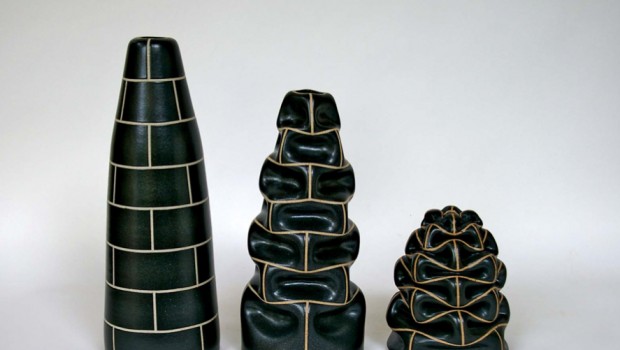
ONE DOESN’T DO WHAT ONE WANTS BUT WHAT ONE CAN. The earthenware I’ve made over the last 30 years is not what I originally wanted to make. In spite of this, after so many thousand of pieces as incredible as it might appear—and may be—ceramics is not always what I wanted to do.
I remember clearly the first profession that captivated me was writing. As a voracious reader since childhood, this was understandable and I still remember those first attempts at writing that even for my ingenuous criticism proved to be disastrous: I didn’t have anything to say. No matter how hard I tried, I couldn’t come up with anything. Many times since I have thought I needed to meet someone who could have told me that in order to write it wasn’t important to have something to say, but rather, simply, to continue doing it. The time will come when there would be something interesting to say, and perhaps meanwhile I would have developed an aptitude for, let’s say it: the craft. But in short, this didn’t happen. And, years later in its place ceramics appeared and immediately imposed itself on me as a perfect, inescapable path. Why? I suppose I will never know even though others always enjoy asking me. I have to admit that it is less important to me. The rest is the endless chance to look and find forms that only clay would allow, like no other material. One speaks generally of Plastic Arts, but I am convinced that in no other instance is it a better designation than ceramics: clay and plasticity are almost synonymous. The plastic expression of ceramics is unlimited, and in order to prove it, it is sufficient to see the abundance of offerings that currently can be found. There are new ones, never before seen, even though humankind has created ceramics for 25000 years, according to recent archeological discoveries.
After 30 years I admit that I’m glad that I didn’t dedicate myself to literature; I continue not having a lot to say. Luckily, ceramics isn’t explained with words: you see it, you touch it, you feel it. Therefore, I don’t try to say anything in relation to my work, and I suppose it has been my only chance to fulfill that childish dream of writing: writing with clay.