
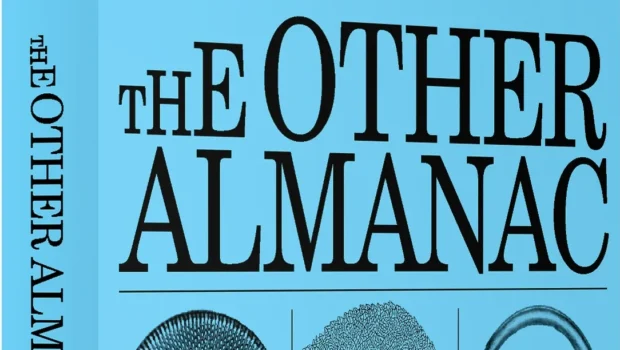
THE OTHER ALMANAC 2027
THE OTHER ALMANAC 2027
Neus Bohigas Mur
|
Getting your Trinity Audio player ready...
|
A Year to See Differently
There’s something endearing about almanacs. Maybe it’s because they belong to a tradition in which the passage of time could still be organized around the seasons, the moon, harvests, festivals, weather, and a seemingly whimsical accumulation of knowledge. They were books meant to be consulted, but also to be leafed through — objects that invited you to stop on any random page and discover something you didn’t know you wanted to know.
The Other Almanac: Calculated for the Year 2027, compiled and edited by Ana Ratner, recovers that tradition and completely transforms it. Inspired by The Old Farmer’s Almanac but conceived from a contemporary, urban, ecological, and deliberately eccentric perspective, the book proposes a different way of moving through the year: paying close attention to what usually goes unnoticed, and recognizing the connections between natural phenomena, everyday objects, languages, animals, plants, technologies, and ways of life.
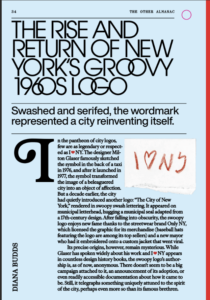 The result is a book that’s hard to classify, and precisely for that reason, very enjoyable. There are essays, calendars, data, illustrations, stories, recipes, maps, and visualizations. There are fungi and soil health, flowers and fruits, frog sounds, lunar cycles, objects found in Central Park, and even a compilation of the most unusual calls received by New York’s 311 service. This diversity of subjects isn’t driven by a desire to accumulate information for its own sake — what holds the whole together is a deeply attentive curiosity about the world.
One section that interested me most is the one devoted to things that disappeared in 2026. Among the farewells are languages, technologies, plants, and animals, but also New York’s MetroCard. Including a seemingly trivial object alongside species and natural systems reveals something important about the book’s spirit: our relationship with the world is made up as much of major ecological processes as of small objects that end up becoming part of our memory.
And it is precisely memory that runs through this almanac. A calendar doesn’t just organize the future; it also records what we’re losing. It reminds us that every year brings births, cycles, transformations, and disappearances. In an era marked by climate emergency and by a technological acceleration that renders objects and habits obsolete at dizzying speed, this awareness of time takes on particular weight.
Ratner also achieves something that isn’t easy: talking about ecology without turning the book into a manual. Knowledge is present everywhere, but so is play. Information coexists with humor and surprise, and design plays a fundamental role. The Other Almanac is a book to read, but also to look at. Its pages are full of color and forms of visual organization that make even the most specialized information accessible.
There’s a generous conception of reading at work here. It’s not about reading the book necessarily from beginning to end, but about entering and leaving it. Opening it to any page. Letting yourself be carried away by an image, a fact, a story, or a question. Coming back later. As with old almanacs, its structure allows curiosity itself to become a form of navigation.
But behind its apparent lightness lies a much more serious question: how do we want to relate to the world we inhabit? The book looks at nature not as a backdrop separate from us, but as a network of systems we’re part of. To talk about soil is to talk about food; to talk about fungi is to talk about ecosystems; to talk about a plant or an animal that has disappeared is also to talk about our own vulnerability.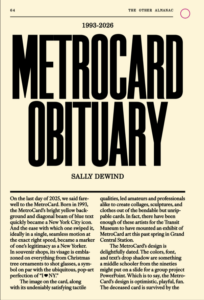
Perhaps that’s why it’s especially fitting that this project takes the form of an almanac. The almanac belongs to cyclical time: spring, summer, fall, winter; sowing and harvest; new moon and full moon. Our era, by contrast, seems bent on making us live in a permanent, accelerated present, where everything grows old before we’ve finished getting to know it. The Other Almanac recovers the possibility of paying attention to cycles and, at the same time, of asking what happens when those cycles begin to shift.
There’s also something very New York about the book. Although its concerns are universal, the city constantly appears as a laboratory of observation. Central Park, its human and non-human inhabitants, its objects, its data, and its peculiarities become subjects of knowledge. The city stops being the opposite of nature and appears instead as one of its possible territories.
I like to think that this is one of The Other Almanac‘s most interesting contributions: reminding us that nature isn’t only found in remote forests or in landscapes we imagine as untouched. It’s beneath our feet, in the plants growing through the pavement, in the insects we ignore, in the food that reaches our table, in the animals that share our cities, and even in the sounds we’ve stopped listening to.
At a time when news of ecological and climate crisis abounds, a book like this could have limited itself to warning us. Instead, it chooses something harder and perhaps more effective: awakening curiosity. Because looking closely is also a form of caring. And perhaps, to protect what we still have, we first need to rediscover it.
The Other Almanac 2027 is, in that sense, a book to consult and to give as a gift, but above all a book to keep close by. A peculiar map of the year ahead, full of information, beauty, humor, and small revelations. A reminder that we can still learn to look at the world — even the most everyday parts of it — as if we were seeing it for the first time.
Neus Bohigas Mur is a consultant in corporate communication and strategy, with more than two decades of experience in public relations, organizational development, and brand management in Mexico. She currently serves as Project Manager at Literal, Latin American Voices, the bilingual (Spanish/English) magazine and publishing house dedicated to promoting Latin American literary voices. She has held leadership positions in corporate communication and holds a degree in Communication from the Universidad Iberoamericana, along with a certificate in Organizational Development from ITAM.
©Literal Publishing. Queda prohibida la reproducción total o parcial de esta publicación. Toda forma de utilización no autorizada será perseguida con lo establecido en la ley federal del derecho de autor.
Las opiniones expresadas por nuestros colaboradores y columnistas son responsabilidad de sus autores y no reflejan necesariamente los puntos de vista de esta revista ni de sus editores, aunque sí refrendamos y respaldamos su derecho a expresarlas en toda su pluralidad. / Our contributors and columnists are solely responsible for the opinions expressed here, which do not necessarily reflect the point of view of this magazine or its editors. However, we do reaffirm and support their right to voice said opinions with full plurality.