
In the name of the Father
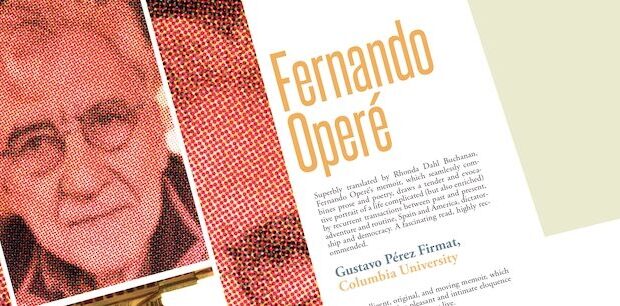
Fernando Operé

Tr a n s l a t e d
by Rhonda Dahl Buchanan
I’m in Washington, D.C., where my oldest son lives. He’s light-hearted and carefree, a veritable whirlwind. He’s passionate about cooking, acting, sports, politics, and anything controversial. A good appetite is necessary if you’re going to devote yourself with enthusiasm to gastronomy, at least with the passion he expends among pots and pans, spices, and aromas. Today, cooking is an art. Creativity and panache are essential to this concoction of fire, condiments, and sauces. We live in a time when chefs are media super-stars. They appear on TV programs, in magazines, and the news. They attend inaugurations, flaunting a prestigious international reputation that comes with today’s age of globalization. Before (and when I say before I mean that indefinite time in which all eras belong, those times I know and those I imagine), women did the cooking, as was expected of them. They also washed clothes and dutifully obliged carnal urges. Back then, those services were rendered without a salary, promotions, medals, or pensions. Women cooked and that was that. Relegated to the kitchen, they found themselves in desperate need of learning how to cook, and so they turned to their mother’s recipes or their grandmother’s, who in turn had inherited them from other mothers and other grandmothers. They learned the basics with finesse or indifference, and passed them on to their daughters who replicated the traditional recipes to a T. Those were perhaps the only recipes. It’s not surprising that this culinary tradition is cherished for its ties to the family legacy, home, and blood. That goes for regional inheritance as well, with dishes prepared from local products and served in venerable establishments.
It’s different now. Invention and renovation are what matter. The kitchen has been transformed into an experimental laboratory, inspired by the example of Ferrán Adrià, the chef who launched gastronomy to the firmament of Michelin stars, or to the deepest depths of the dark seas where giant squid and seaweed coexist.
My son became enthusiastic about cooking after following the timid footsteps of his father, but primarily out of hunger and an abundance of creativity. A prototype of his generation, he loves to watch great chefs on cooking shows, and then in the company of a friend equally enthralled by the new wave, try out recipes, always with an element of risk and surprise. Without risks, life would be bland, like soup without salt, or a cocktail without alcohol.
I’ve come to DC to take care of my grandchildren. My son and his wife wanted to celebrate an anniversary and asked us to look after their kids, a six-year-old boy, and a threeyear-old girl. At first, I was concerned. It had been a long time since I put my parenting skills into practice on small children, and grand fatherhood fell into my lap like an opportunity to refresh my skills. To what extent should limits be imposed, at what point should order be levied over the natural disorder of children, and should the voice of authority ever prevail over their natural chaotic impulses?
I have four children and never have I wielded an ironclad paternal authority over them or laid a hand on them, even in the most trying moments of pure turmoil, after they knocked over a fish tank with gallons of water, shattering it to bits and leaving the helpless little goldfish gasping in vain for air on the rug. Even then I didn’t smack them on the rear. Back then (once again that undefined era to which I didn’t belong, or did unconsciously), it was understood that corporal punishment was not only an acceptable way to raise children, but a laudatory method. “That’s how to make them stronger,” they used to say, or “let them learn the hard way.” I suppose a good measure of military discipline was baked into that formula when I was a boy. The truth is our beatings varied in harshness, from one moment to the next, according to the level of the committed infraction. Sometimes it wasn’t necessary to justify the pedagogical benefit because it was understood that punishment was always enlightening. My grandfather used to scare us by threatening to remove his belt. Then he’d take it off to make the threat seem more real, although he never followed through with it. I remember one summer in Talavera de la Reina, near the Tajo River, where I’d spend summers in my aunt and uncle’s house. An enraged father had caught his son bathing in the river without his permission. Overwrought because he’d managed to prevent a tragic accident, or simply out of a keen sense of paternal duty, he punished his son’s disobedience by parading him naked through the streets of the town, which at that time was much larger than a town, all the while whipping him on the rear with his belt. What must the people watching have thought about such a display of brutality? Would their remarks be laudatory or critical? “That’s the way to teach your children,” might’ve been heard. “Well done, he’ll learn to obey now,” although the repeated use of that term “obey” inevitably leads to rebellion. My mother responded to our infractions brandishing a slipper in the air and running after us down the long hallway of the house. I’d escape through the window thinking I didn’t deserve such a disproportionate punishment. On the other hand, my brother Mariano would endure with stoic discipline the shower of slipper swats administered by my poor mother after our riotous acts had propelled her into a choleric state, although by nature, she was serene and sentimental.
In the school of the Hermanos de la Salle, where they supposedly educated me,– what a misleading expression –, they also punished us physically for something as ridiculous as not remembering the name of a king, or the sailor who spotted land on Christopher Columbus’s first expedition. They’d beat us with a wooden ball from a contraption designed to keep time, but used by Brother Ceferino for more menacing tasks, to say the least. So, considering such an upbringing, and the adage you are what you eat, I should’ve turned out to be an experienced disciplinarian given I’d personally suffered the excessive fits of rage of my educators, at school and at home. But no, it didn’t turn out that way, and not for lack of will. I thought about it, weighed it over, and felt there was no reason, no matter how great the offense, for me to put my broad, heavy hand on the tender body of my children. And I never did.
I watch my grandchildren as they play their absurd, nonsensical games, as children’s games seem in the eyes of adults. I imagine children think the same thing about our games. For the most part, adults stop playing games, opting instead to drink beer senselessly and laugh at someone’s stupid remarks. At times, anger prompts us to scream for no real reason and say harmful and terrible things that only a poisoned heart knows how to say. Or we try to outdo each other, breaking records that only serve to feed dark and sinister egos, which emerge when we haven’t learned to contemplate pine trees and boulders on a cloudy afternoon, or the savage landscape on a clear summer morning. There’s an indecipherable communication between swifts in flight and the air, between clouds and the craggy mountain peaks, between humble wildflowers and crystalline streams. And between our gaze and our skin, the smell of the rain and the sweet autumn breeze. But we learn so little from that language. Perhaps with time and steadfast contemplation, we may discover those ephemeral secrets.
Is a child’s gaze better? Does our gaze become clouded when the desires of greed and comfort surface and launch the quest for fleeting triumphs wrapped in all the material forms that come our way?
It’s the overwhelming presence of capitalism. And who am I to criticize it? I tell my friends that I’m a bourgeois who only acquires objects of quality, which happen to last longer. I say it in jest, but maybe that’s how I feel. Part of my success in life harkens to my humble origins and my escape from the near poverty that engulfed the family when my father left us at only forty-four years of age. Untreatable elevated levels of cholesterol took him away. An air of bereavement filled the house. An overwhelming sadness penetrated the hallway, seeped into my mother’s kitchen, into the olive oil and charcoal, into the pots and wooden spoons, plates, and cupboards, and no one could escape that thick and sorrowful tragic mass that took up residence in the house for years. It rose from my mother’s eyes, and like a nocturnal tide, swept over the kitchen, the beds and the blankets, the pencils in their case, and the sandals my father would buy us every summer in the Segarra shoe store.
This excerpt belongs to the book In the Name of the Father, Chronicle of Franco’s Spain to Trump’s America and you can find it here.
Posted: April 1, 2025 at 8:31 pm