

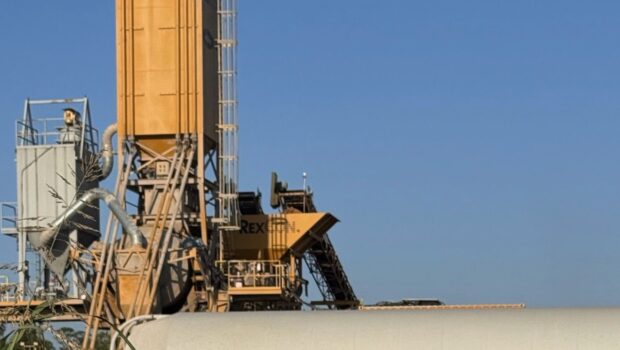
A Dangerous Neighbor
Rose Mary Salum

More than twenty-five years ago, I enrolled my children at Awty International School. I wanted them to have the best academics, exposure to multiple languages, and the beauty of an environment where diversity and curiosity were nurtured. Awty gave them all of that and more.
My children were not just educated there—they were shaped by the school’s values of respect, tolerance, and international-mindedness. They grew up speaking three languages, embracing cultures not their own, and developing tools that carried them into adulthood. Today, I watch my grandchildren carry those same lessons forward at Awty. The school has become a generational legacy in our family, a place that feels like home.
But that home is now under threat.
A Dangerous Neighbor
Earlier this month, as families prepared for the start of the new school year, we learned that Webber LLC, a contractor for the Texas Department of Transportation (TxDOT), had been granted permission to operate a concrete batch plant less than 300 yards from Awty International School, a nearby day care, and an autism center.
The reaction was immediate and visceral: disbelief, anger, and fear. Parents and grandparents—myself among them—asked the same questions: Why would the Texas Commission on Environmental Quality (TCEQ, the agency charged with public safety, approve such a permit? Why place a facility that produces silica-laden, carcinogenic dust within breathing distance of toddlers and schoolchildren?
Houston’s lack of zoning has long been a challenge, but it does not excuse government agencies from exercising discretion. Approving a concrete plant next to schools is not just careless—it is reckless.
What We’ve Learned in the Last Few Weeks
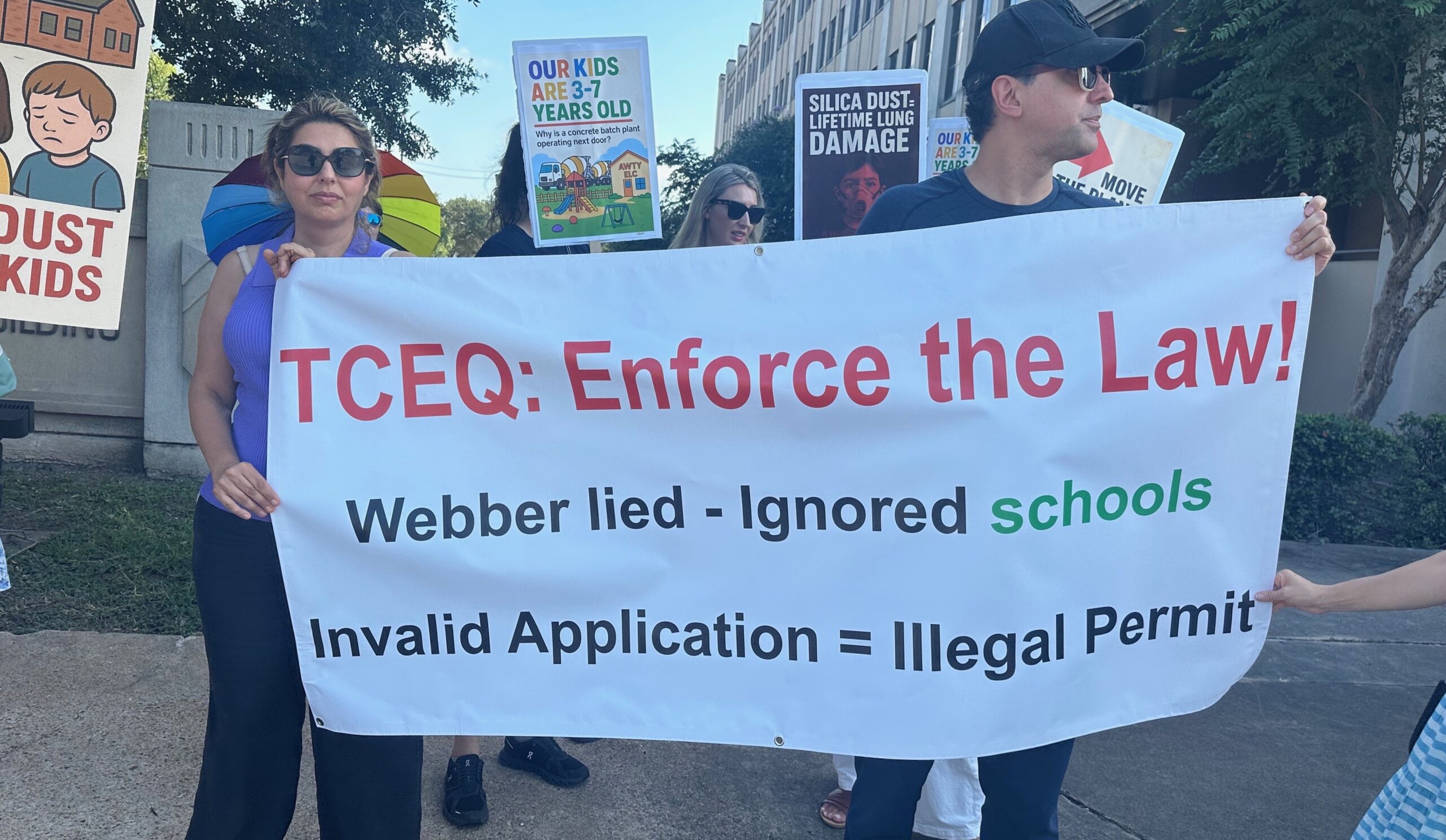
As parents and grand parents, we have protested outside TxDOT’s Houston offices, Webber LLC, TCEQ and more. We’ve been demanding the plant to be relocated. More than 2,000 people have signed a petition calling for action, and over 30 formal complaints have been filed with the Texas Commission on Environmental Quality (TCEQ) since mid-July.
The plant, which relocated to its current site in December 2024, operates under a temporary permit that allows it to sit as close as 100 feet from “sensitive receptors” like schools. By contrast, permanent plants require a quarter-mile buffer. This loophole exposes children at Awty and nearby centers to dust and diesel exhaust that medical experts say can contribute to asthma, lung disease, and cancer.
Even more troubling, The Texas Commission on Environmental Quality has not fully disclosed the details of the permit. According to local coverage, the agency has reserved the right to withhold key information, leaving families in the dark about how and why this plant was approved in the first place. A statute clearly requires regulators to evaluate whether schools exist within 3,000 feet of such facilities. Yet, here we are, with schools and day cares well within that range.
Progress, in the form of highway construction, is important. But if progress comes at the expense of children’s health, then we have crossed a line.
A Community’s Legacy at Risk
For our community, this fight is deeply personal. Awty is more than a school—it is a second home that has shaped many generations of Texans. It is unthinkable that while they are learning to be global citizens, they may also be inhaling dust containing silica, coming from industrial trucks and concrete mixers across the street. It is unthinkable that while the school instills values of responsibility, transparency, and care, government agencies are modeling secrecy and disregard.
This is not simply about Awty, or the day care centers next to the batch. It is about the principle that children deserve to breathe clean air in their classrooms. It is about the responsibility of public officials to place community health above bureaucratic expediency.
What Must Be Done
The answer is clear: TCEQ must act now—either relocate the Webber concrete batch plant immediately or revoke the permit that was allegedly granted under unclear circumstances.
The plant’s current location is incompatible with the presence of schools, day cares, residential neighborhoods, and community facilities—including the Houston Rockets’ training center—within a short radius (just 200 and 300 yards away from the plant). Every day that this facility remains in place, children and families are placed at unnecessary risk.
The state has the authority to correct this mistake. What is needed now is the will.
A Call to Protect the Future
When I enrolled my children at Awty decades ago, I wanted to give them the tools to navigate the world with confidence and compassion. I wanted them to inherit not only skills, but values. They did, and today, those values live on in their own children.
But if we fail to act now, we betray that inheritance. We teach our children that contracts matter more than lives, that opacity is stronger than accountability, and that health is negotiable. That is not the legacy any of us should want to leave.
The people of Houston have spoken: families, educators, doctors, and community leaders are united in opposition. It is time for TCEQ to listen, to lead, and to place children’s well-being where it belongs—at the center of every decision.
Relocate the plant. Protect our children. Safeguard the legacy of education and community that makes Houston strong.
Anything less would be indefensible.
 Rose Mary Salum is founding editor of the bilingual literary magazine Literal: Latin American Voices and Literal Publishing. She has authored 10 books and received a number of awards. Her books have been translated to English, Italian, Bulgarian & Portuguese.
©Literal Publishing. Our contributors and columnists are solely responsible for the opinions expressed here, which do not necessarily reflect the point of view of this magazine or its editors. However, we do reaffirm and support their right to voice said opinions with full plurality.
Posted: September 4, 2025 at 6:44 pm




I started Nursing School in 1972, switched and became a Registered Respiratory Therapist in 1993. That plant’s silica and other particulates are a clear and proven threat to lung tissue. The damage is analogous to Black Lung Disease. Further, diesel fumes are toxic. Issuing permits for that location is GUARANTEED to cause physical harm to children attending facilities with decades of pre-existing tenancy. Texas is a big state. Relocate. STOP taking payouts and do right.
PLEASE RELOCATE THE PLANT. Profit should never come first when children’s or anyones health is at risk.