
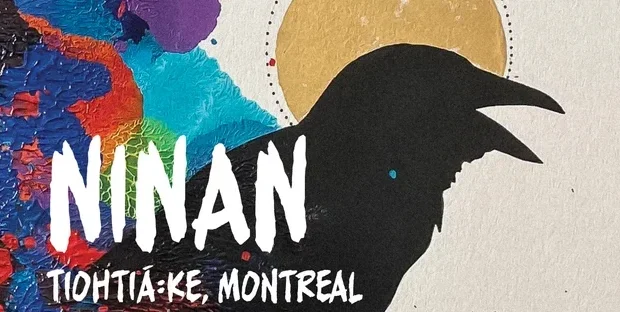
Ninan Tiohtiá:ke, Montreal
Michel Jean

TWINS
The Amir restaurant is just across from the park, on the corner of Sainte-Catherine and Berri, and the conspicuous sign for the Lebanese eatery catches his eye. None of the dishes on the menu hanging above the counter sound familiar. He orders the shawarma because it’s one of the few beef dishes on offer and the daily special. He downs his meal quickly, without savouring it, to ease his hunger. The too-spicy taste of the meat lingers in his mouth.
“Hey! Got any change?”
The raspy voice pulls him from his thoughts.
“Just a loonie maybe?”
Two tiny, skinny women stare up at him. With their brown skin, their round faces criss-crossed by a thousand small lines and their almond eyes, the twins, Mary and Tracy, could be taken for Innu.
“You from the North Shore?” he asks.
“You think I look Innu?” they chorus before bursting into laughter.
Somewhat offended, Élie scowls.
“No,” says Mary with a smile. “We’re from the Far North.”
They’re Inuuk. In prison, he’d known an inmate from Kangiqsualujjuaq, Nunavik, who often talked about his homeland. The man described a world without trees, and Élie had trouble imagining such a barren place. After all, even here in Montreal, there are trees everywhere. The Inuit make their living from the sea and not the forest like the Innu, but life in Kangiqsualujjuaq, as described by the Inuk man, was not unlike the one Élie had led in Nutashkuan.
“Where are you from?” Mary and her sister have the same timbre to their voices, and both wear threadbare clothing. One sibling sports a frayed hat with a broad brim, the other a faded Expos baseball cap. Aside from that one detail, the only way to tell the twins apart is the missing incisor when Tracy smiles, a souvenir from a hard-won fight.
“Nutashkuan,” says Élie in his gentle voice.
“Ahhh,” says Tracy. “You’re far from home. Did you just get off the bus?”
He nods.
The twins have seen many a woman and man arrive from the North or the East and vanish into the crowd. Now some of those, like them, live on the street. Others found work.
“Émilie-Gamelin isn’t a great spot. Too many people and you’ll be the only one of your kind here,” says Mary, eyeing the crowd of workers, UQAM students, gawkers, and tourists around them.
“And there are too many cops,” Tracy adds with a laugh.
The sisters invite him to tag along, and the unusual trio sets off at the slow pace of those who have nothing waiting for them. At first, they take Sainte-Catherine, then Saint-Laurent Boulevard till they reach the imposing concrete archway painted red with its elaborate gilded top that marks the entrance to Chinatown. Many of the people they pass on the sidewalk have almond eyes. Suddenly, Élie remembers the inmates who used to make fun of him, calling him “the Chinaman.” It made him angry, not because he had anything against the Chinese—in fact, he’d never met any in his lifetime—but because it was as though they were denying him his identity. His temper had earned him several scars.
The twins suggest he wait for them in the vacant lot just east of the intersection of Saint-Laurent and René-Lévesque boulevards, south of Sainte-Catherine.
“It’ll take us a couple of hours,” says Mary.
The Nappatuk sisters get to work, wandering from one stopped car to another at the traffic light. Most drivers ignore their outstretched hand, but Tracy’s smile with its missing tooth attracts some sympathy, and a few give her a bit of change, which Mary is quick to grab before they think better of it.
Sitting on a cement block, Élie watches the frail Inuuk women as they roam between the vehicles. He can’t rid himself of a persistent, suffocating sensation and feels a deep emptiness inside.
“C’mon.”
The raspy voice of one of the sisters rouses him from his thoughts once more and instantly tamps down the anguish consuming him. The trio heads west along René- Lévesque. The twins step into a convenience store while he waits outside on the sidewalk. They come out carrying three large bottles of Labatt Blue. Together they walk to Atwater, where they turn north and continue as far as a small park dominated by a large bronze sculpture of one of Christopher Columbus’s contemporaries, the Italian explorer John Cabot, who, on behalf of King Henry VII of England, explored the shores of North America in his quest for a maritime route to China. Cabot never discovered such a route, nor did any other explorer, for that matter, and he ended up lost at sea without a trace. Even so, his bronze likeness reigns over the park where Indigenous folk come to find shelter.
To Élie, Cabot Square is an island of greenery in the heart of the city where tall trees give off their woody perfume. It almost feels like being back on the reserve except that, here, there are Atikamekw, Cree, and Inuit, as well as a few Innu.
He sits under a maple tree with the Nappatuk sisters. Mary and Tracy each open a bottle and take a swig. Élie stares at the bottle in his hand. He hasn’t had a drop of alcohol in ten years. Not since that night. His last night in his own home. He opens it. The beer splashes against the back of his throat. He thinks back to prison, where drugs circulate almost freely. He did do some, but they messed him up rather than helping him forget, and eventually, he didn’t bother. Anyway, back on the reserve, he’d always preferred drinking to smoking marijuana, which many of his friends did daily. He takes another swig and, closing his eyes, can almost see himself back on the reserve, breathing in the scent of the spruce trees and of the sea.
Purchase here
MICHEL JEAN is an award-winning writer, and former news anchor and investigative journalist, much appreciated by the Quebec public. He worked at Radio-Canada and the Quebec television network TVA before devoting himself full-time to his writing. He has published over a dozen books including his bestselling novels Kukum, an exploration of his Innu roots and winner of the Prix France-Québec, and Qimmik, which deals with a harrowing chapter of Inuit history. His work has been translated into several languages. his most recent novel being Kabasa. Michel Jean has also edited two short story collections featuring Indigenous voices: Amun, released in fall 2016, and Wapke, published in May 2021, both of which are available in English. Michel Jean is Innu from Mashteuiatsh, and his native origins resonate in many of his writings.
©Literal Publishing. Queda prohibida la reproducción total o parcial de esta publicación. Toda forma de utilización no autorizada será perseguida con lo establecido en la ley federal del derecho de autor.
Las opiniones expresadas por nuestros colaboradores y columnistas son responsabilidad de sus autores y no reflejan necesariamente los puntos de vista de esta revista ni de sus editores, aunque sí refrendamos y respaldamos su derecho a expresarlas en toda su pluralidad. / Our contributors and columnists are solely responsible for the opinions expressed here, which do not necessarily reflect the point of view of this magazine or its editors. However, we do reaffirm and support their right to voice said opinions with full plurality.
Posted: September 15, 2026 at 5:14 am