
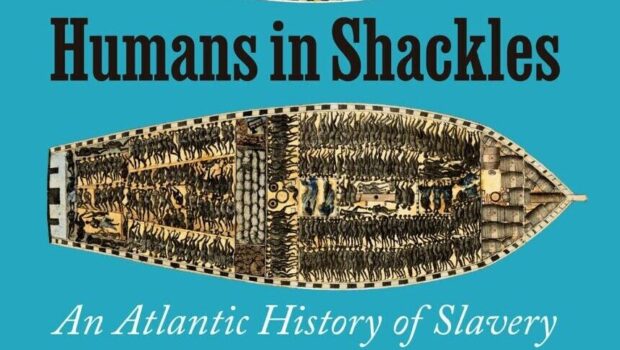
Humans in Shackles: An Atlantic History of Slavery
Ana Lucia Araujo
|
Getting your Trinity Audio player ready...
|

Spanish Americas and the West Indies
With the rise of the Atlantic slave trade, Black enslaved and freedwomen sold goods in the streets and markets of various urban areas in the Americas as well. Still, in cities of Mesoamerica such as Mexico City and in the Andean region, including Potosí, Santiago, Lima, and Quito, Indigenous women dominated marketplace activities as sellers. In all these cities, Black women mingled with Indigenous women. They navigated streets and public markets looking for opportunities to improve their lives, increase their earnings, and obtain a path to freedom. As early as in 1656, the Spanish administration threatened to punish Black and Indigenous women who exchanged goods stolen from their owners, such as bacon, cheese, bananas, fruit, peanuts, and unrefined whole cane sugar, for valuable goods such as gold jewelry, as well as silver spoons and forks. In the late eighteenth century, Black women marketeers were also visible in the Pacific Ocean port city of Lima in Peru. Czech naturalist Thaddeus Xaverius Peregrinus Haenke observed that although white, Black, Indigenous, and mixed-raced individuals all congregated in Lima’s central square’s public market,the women selling food at the marketplace were all Black. Overall, enslaved, freed, and free Black women vendors predominated in the cities of regions with smaller Indigenous populations and where the presence of enslaved Africans and their descendants was huge, especially in Brazil and the West Indies.
In the British West Indies, enslaved women marketeers and peddlers were known by several terms, such as hucksters, higglers, and 240 Women Who Fed the City hawkers. In Barbados, as early as the middle seventeenth century, colonial authorities made efforts to regulate the activities of enslaved peddlers, most of whom were women. Black female prevalence continued to be visible in later years. Bridgetown’s Milk Market, located near Swan Street to the west, was controlled by enslaved and free women marketeers in the eighteenth century. Bondswomen toiled in great numbers at the great market in Cheapside as well. Found nearly everywhere in the city, they sold nonagricultural products, includingcakes, drinks, and imported items.
In 1708, an act prohibited slave owners from employing enslaved men and women as street vendors in Barbados. As the measure was not successful, colonial authorities attempted to dissuade the activities of street vendors by adding a provision that required enslaved people selling milk, horsemeat, or firewood to wear a metal necklace attached to the neck or leg displaying, among other information, the owner’s name and address. Despite increasing attempts to restrain and punish their activities, Bridgetown’s enslaved kept selling food in the streets Official resolutions to limit the circulationof bondswomen street vendors continued and expanded during the eighteenth and nineteenth centuries, with British and French colonizers passing legislation to prohibit enslaved people from selling goods in towns of other British colonies and the French West Indies But as in Barbados, enslaved women always found ways to circumvent the restrictions. At the end of the day, colonial cities could not survive without the hard work provided by enslaved women marketeers andpeddlers.
In the French West Indies, slave owners made profits from the work of enslaved women street vendors. In Saint-Domingue, bondswomen performing market activities in the city sought to make money and also found opportunities to escape. An ad from 1766 described a runaway African-born enslaved woman identified as Mina who worked selling bread at Cap Français. As discussed in chapter 6, the term “Mina,” broadly used in Brazil and other parts of the Americas, identified African captives who had been embarked in ports situated alongthe Bight of Benin, and in several cases was a reference to Yorubaspeaking women. Another ad from 1775 sought Rose, an African-born enslaved woman who peddled in the streets selling bread. Although identified as “Congo,” she was probably transported to the Americas from the Loango coast, and also escaped bondage in Cap Français
In other French colonies the activities of enslaved women street vendors continued to be visible during the nineteenth century. For example, on the eve of the French abolition of slavery in the 1840s, one observer reported the case of a female slave owner of Basse-Terre, in Martinique, who purchased bulk goods and put her enslaved women to work selling them in the city. In addition, urban and rural bondswomen could also be found in the city selling their own products. In other words, these women could come to the marketplace on a regular basis not only to congregate with other enslaved and free persons but also to sell meats and the foodstuffs they grew in their own gardens such as herbs, melons, manioc, and sweet potatoes, as well as chickens and eggs.Moreover, bondswomen visited the market to purchase and exchange goods for themselves and their owners. In some places, bondspeople bartered for food to improve the meager and monotonous diet offered to them at the plantations. Enslaved women who worked in the city or on neighboring farms and plantations went to urban markets not only to sell food surpluses but also to develop social connections that would possibly get them access to economic opportunities.
Similar realities existed in the Spanish West Indies. The rising sugar economy of the Spanish colonies of Cuba and Puerto Rico propelled the development of the economies of the two islands and the growth of its main cities. In Havana, at the end of the eighteenth century, women composed 60 percent of the city’s enslaved population. By 1871, women still represented more than 50 percent of Havana’s enslaved population. As in other cities of the West Indies, Black women peddlers (enslaved, freed, and free) sold food in the streets and markets of Cuba’s biggest city. Likewise, in San Juan, on the island of Puerto Rico, women composed most of the city’s population by the end of the eighteenth century. Black women, including those in bondage, worked in urban spaces selling food and drinks as small retailers and resellers. Some of them were also owners of small shops and businesses that prepared and sold cooked food. For example, in the streets of San Juan and other Spanish cities in the Americas, women who prepared and sold mondongo (a tripe stew) and were called mondongueras were mostly of African descent. But one must consider possible deeper links between these African-descended women street vendors and the mondongo they sold in San Juan’s streets. Indeed, the term mondongo exists in Portuguese, where in the south of Brazil it still refers to the tripe stew. But more important, during the era of the Atlantic slave trade, especially in the eighteenth century, enslaved Africans of the Mondongue “nation” who had been embarked in the ports of the Loango coast appear in numerous records of the French slave trade to Saint-Domingue. Today, it exists in the toponym Mondongo (a city in the present-day Democratic Republic of the Congo). In San Juan, as in other cities of the Americas where Black women peddlers predominated, mondongueras were also persecuted. City officials perceived them as untrustworthy and often attempted to stop their activities by arguing that their establishments stayed opened until late at night and attracted other Black individuals, including fugitive slaves. Still, these frequent efforts to stop their activities were useless. San Juan’s Black women persisted in selling mondongo, a dish still popular in many Latin American countries today. During the era of slavery, streets and public markets remained sites of resistance for bondswomen and freedwomen who tried to find ways to improve their dire conditions.
The book is available here
The University of Chicago Press
 Ana Lucia Araujo is professor of history at Howard University in Washington, DC. She is the author or editor of fifteen books, including, most recently, The Gift: How Objects of Prestige Shaped the Atlantic Slave Trade and Colonialism. Her work has appeared in publications including the Washington Post, Slate, and Newsweek.
© Literal Publishing. Queda prohibida la reproducción total o parcial de esta publicación. Toda forma de utilización no autorizada será perseguida con lo establecido en la ley federal del derecho de autor
Las opiniones expresadas por nuestros colaboradores y columnistas son responsabilidad de sus autores y no reflejan necesariamente los puntos de vista de esta revista ni de sus editores, aunque sí refrendamos y respaldamos su derecho a expresarlas en toda su pluralidad. / Our contributors and columnists are solely responsible for the opinions expressed here, which do not necessarily reflect the point of view of this magazine or its editors. However, we do reaffirm and support their right to voice said opinions with full plurality.
Posted: September 24, 2025 at 8:18 am