Oaxaca lives in the work of Fernando Andriacci. It is impossible to think that his cosmology was created apart from the pictorial tradition of southern Mexico —from the school of Toledo or from the flora and fauna of a land that feels inherently magical— and yet, that very singularity has allowed his visual language to expand across the world. Oaxacan art has conquered the global imagination, and within it, Andriacci’s work holds a luminous and distinctive place.
His creation unfolds between joy and myth. On one hand, it radiates an explosive yet introspective colorfulness at a time when much of Western art seems inclined toward darkness, critique, and conceptual exhaustion.
In Andriacci’s work, composition becomes a playful space where color, form, and movement spring from an inexhaustible source of collective imagination. His canvases do not merely represent: they play, they expand, and they intertwine with Oaxaca’s visual tradition—a region where fantasy is a natural way of perceiving the world. As in the plastic dreams of Tamayo or Toledo, in Andriacci imagination is not an individual artifice but a shared energy, inherited from myth, nature, and daily life. His painting emerges from the same creative soil that nourishes his fellow artists, yet it distinguishes itself by its jubilant and expansive tone—by that impulse that transforms the pictorial surface into a territory of visual festivity.
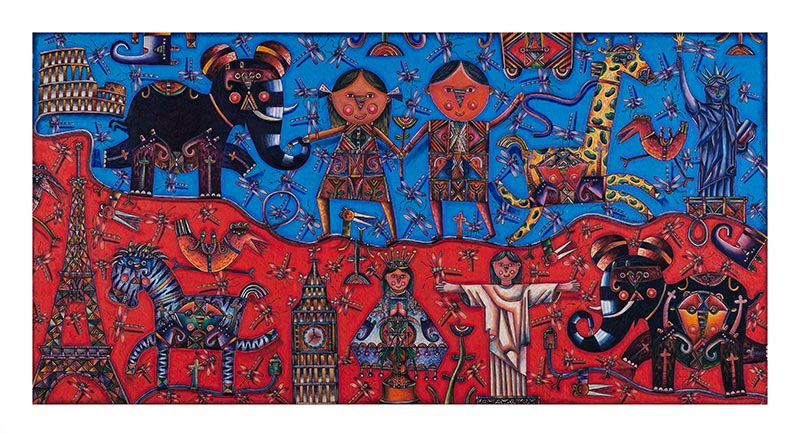 However, this joy does not float only on the surface: it is anchored in both Oaxacan and European artistic history, drawing sustenance from the pulse of tradition and its way of representing life. His paintings, sculptures, and reliefs transcend any decorative intention; they narrate coexistence. They reveal how the forms of life—human, animal, ancestral, or imagined—share an identity and recreate their meaning together.
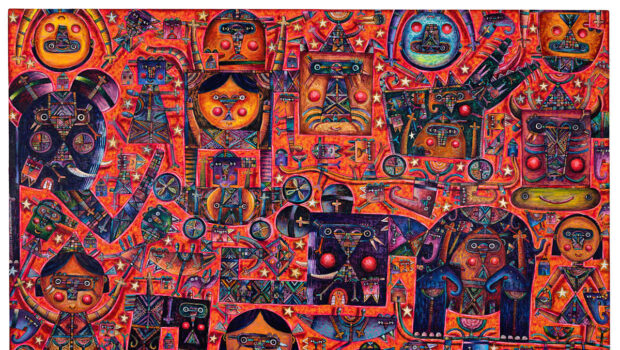
In La verbena, a crucial work in his career for its technical innovation and use of materials, the characters allude to the instinctive curiosity of the voyeur: they observe us and, in doing so, grant us existence—like the members of the court gazing from Velázquez’s Las Meninas. Those gazes return us to self-awareness: we recognize ourselves as mere spectators who add an emotional dimension to existence. Their eyes, rendered in glossy paint in contrast to the matte universe of the background, transport us to a state of awareness—the state of being here, now, of looking at someone who looks back at us.
On another level, Andriacci’s art takes shape as an atlas of Oaxacan flora, fauna, myth, and matter. In Pareja de elefantes or Conviviendo en armonía, the focus abandons its anthropocentric axis, and we see a pair of elephants pregnant with human beings. His figures, echoing Cubist resonance, are multifaceted: each functions as a mirror containing another mirror, in an infinite sequence of reflections. All the elements he uses are extracted, recomposed, and returned in layers of meaning that converse with one another within each figure, within each composition. The crocodile, the elephant, the dragonfly, or the frog each find their place within his cosmic ecology of symbols, where matter and myth blend into a single vibration.
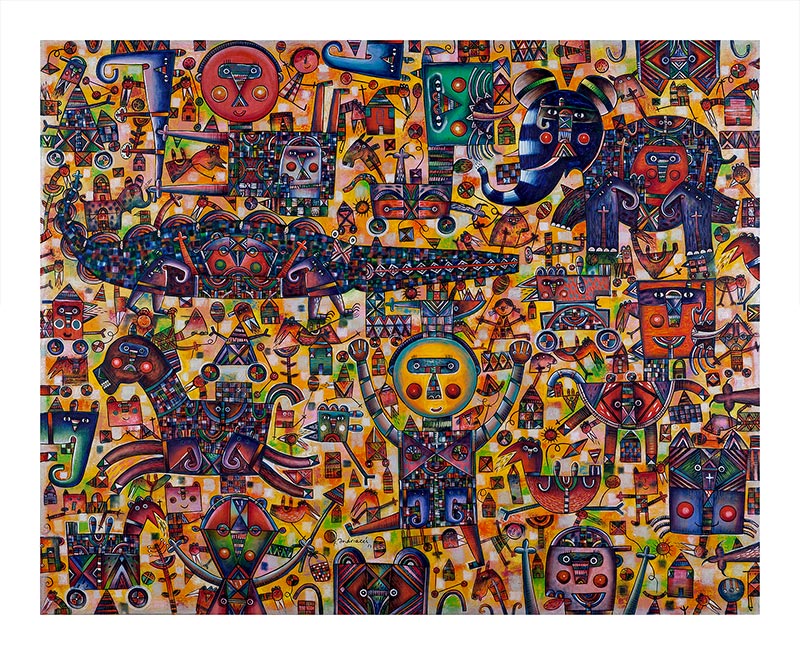
Rostros mágicos 2017 Óleo sobre tela Medida: 120 x 150 cm
In Jungian psychology, every symbol is multifaceted. A jaguar painted in ochre or gold, for instance, is never merely a jaguar—it becomes a receptacle of primordial energy. Andriacci seems to understand this intuitively: his saturated pigments, firm geometries, and overlapping grids do not intensify the literal presence of the animal, but rather its archetypal resonance. The jaguar of Mesoamerican cosmology returns here not as predator, but as companion—agile, humorous, bearer of dreams. The rooster, the grasshopper, and the toad—species emblematic of Oaxacan land—are transfigured into sculptural metaphors of persistence, fragility, and grace.
In Andriacci’s bestiary, these beings are not presented as isolated emblems: they enter into dialogue. They exist within a luminous conversation among themselves, with the viewer, and with the chromatic matrices that embrace them. Here, the collective unconscious manifests in visual form—that Jungian intuition that, across centuries and continents, human beings share a common source of mythical patterns and symbols. Just as Jung affirmed that archetypes cannot function in isolation, Andriacci’s creatures live only through exchange: resonance, friction, and dialogue. All unfolds in an infinite feast of color, where imagination does not impose itself—it blooms.
*Images courtesy of Serrano Gallery
 Rose Mary Salum is founding editor of the bilingual literary magazine Literal: Latin American Voices and Literal Publishing. She has authored 10 books and received a number of awards. Her books have been translated to English, Italian, Bulgarian & Portuguese.
©Literal Publishing. Our contributors and columnists are solely responsible for the opinions expressed here, which do not necessarily reflect the point of view of this magazine or its editors. However, we do reaffirm and support their right to voice said opinions with full plurality.
Oaxaca vive en la obra de Fernando Andriacci. Es inevitable pensar que su cosmología haya sido creada al margen de la tradición pictórica del sur de México —de la escuela de Toledo o de la fauna y flora de un territorio que se antoja mágico— y, sin embargo, esa misma singularidad ha permitido que su lenguaje visual se expanda por el mundo. El arte oaxaqueño ha conquistado el imaginario global, y dentro de él, la obra de Andriacci ocupa un lugar luminoso y propio.
Su creación se despliega entre la alegría y el mito. Por un lado, irradia un colorido explosivo y a la vez introspectivo, en un momento en que gran parte del arte occidental parece inclinarse hacia la oscuridad, la crítica o el agotamiento conceptual.
En la obra de Andriacci, la composición se convierte en un espacio lúdico donde el color, la forma y el movimiento brotan de una fuente inagotable de imaginación colectiva. Sus lienzos no se limitan a representar: juegan, se expanden y se entrelazan con la tradición visual de Oaxaca, región donde la fantasía es una manera natural de mirar el mundo. Como en los sueños plásticos de Tamayo o Toledo, en Andriacci la imaginación no es un artificio individual, sino una energía compartida, heredada del mito, de la naturaleza y de la vida cotidiana. Su pintura emerge del mismo lugar creativo que nutre a sus coterráneos, pero se distingue por su tono jubiloso y expansivo, por ese impulso que transforma la superficie pictórica en un territorio de celebración visual.
Elefantito
Sin embargo, esta alegría no flota solo en la superficie: está anclada en la historia artística oaxaqueña y europea, de donde se nutre del pulso de la tradición y su forma de representar de la vida. Sus pinturas, esculturas y relieves trascienden cualquier afán decorativo; narran la coexistencia. Revelan cómo las formas de vida —humanas, animales, ancestrales o imaginadas— comparten una identidad y recrean su significado en conjunto.
En La verbena, una obra crucial dentro de su trayectoria por la innovación técnica y el uso de materiales, los personajes aluden a la curiosidad instintiva del voyeur: nos observan y, al hacerlo, nos otorgan existencia, como los miembros de la corte que miran desde Las meninas de Velázquez. Esas miradas nos devuelven la conciencia de ser —de sabernos meros espectadores que añaden un componente emocional a la realidad. Sus ojos, representados con pintura brillante en contraste con el resto del cuadro, donde domina un universo mate, nos transportan a un estado de conocimiento: el del aquí y ahora, el del mirar a alguien que nos mira.
Por otro lado, el arte de Andriacci se configura como un atlas de la flora, la fauna, el mito y la materia oaxaqueños. En Pareja de elefantes o Conviviendo en armonía, el protagonismo abandona su eje antropocéntrico y vemos a un par de elefantes preñados de seres humanos. Sus figuras, de resonancia cubista, son multifacéticas: cada una funciona como un espejo que contiene a otro espejo, en una secuencia infinita de reflejos. Todos los elementos que utiliza son extraídos, recompuestos y devueltos en capas de significado que dialogan entre sí dentro de cada personaje, de cada composición. El cocodrilo, el elefante, la libélula o la rana encuentran su lugar en su ecología cósmica de símbolos, donde la materia y el mito se confunden en una misma vibración.
Rostros mágicos 2017
Óleo sobre tela
Medida: 120 x 150 cm
En la psicología junguiana, todo símbolo es multifacético. Un jaguar pintado en ocre o dorado, por ejemplo, nunca es solo un jaguar: es un receptáculo de energía primordial. Andriacci parece comprender esto de manera intuitiva: sus pigmentos saturados, sus geometrías firmes y sus retículas superpuestas no intensifican la presencia literal del animal, sino su resonancia arquetípica. El jaguar de la cosmología mesoamericana regresa aquí no como depredador, sino como compañero —ágil, humorístico, portador de sueños. El gallo, el chapulín o el sapo, especies típicas de la tierra oaxaqueña, se transfiguran en metáforas escultóricas de persistencia, fragilidad y gracia.
En el bestiario de Andriacci, estos seres no se presentan como símbolos aislados: dialogan. Existen en una conversación luminosa entre sí, con el espectador y con los matices cromáticos que los acogen. Aquí se manifiesta el inconsciente colectivo en forma visual —esa intuición junguiana, en la que, a través de los siglos y los continentes, los seres humanos compartimos una fuente común de patrones y símbolos míticos. Así como Jung afirmaba que los arquetipos no pueden existir solos, las criaturas de Andriacci viven solo en el intercambio: resonancia, fricción y diálogo. Todo ocurre en una fiesta de color, donde la imaginación no se impone, florece.
*Imágenes, cortesía de la Galería Serrano
Rose Mary Salum es la fundadora y directora de Literal, Latin American Voices. Es la autora de Medio Oriente en México. Antología de escritores de orígen árabe (LP, 2024). Donde el río se toca (Hablemos escritoras, 2024 Sudaquia, 2022), Otras lunas (Libros del sargento, 2022) Tres semillas de granada, ensayos desde el inframundo (Vaso Roto, 2020), Una de ellas (dislocados, 2020). El agua que mece el silencio (Vaso Roto, 2015), Delta de las arenas, cuentos árabes, cuentos judíos (Literal Publishing, 2013) (Versión Kindle) y Entre los espacios (Tierra Firme, 2003), entre otros títulos. Sus obras se han traducido al inglés, italiano, búlgaro y portugués. Es colaboradora en Hablemos escritoras. Su Twitter es @rosemarysalum
©Literal Publishing. Queda prohibida la reproducción total o parcial de esta publicación. Toda forma de utilización no autorizada será perseguida con lo establecido en la ley federal del derecho de autor
Las opiniones expresadas por nuestros colaboradores y columnistas son responsabilidad de sus autores y no reflejan necesariamente los puntos de vista de esta revista ni de sus editores, aunque sí refrendamos y respaldamos su derecho a expresarlas en toda su pluralidad. / Our contributors and columnists are solely responsible for the opinions expressed here, which do not necessarily reflect the point of view of this magazine or its editors. However, we do reaffirm and support their right to voice said opinions with full plurality.







Felicidades por el trabajo profesional que tiene esta revista