
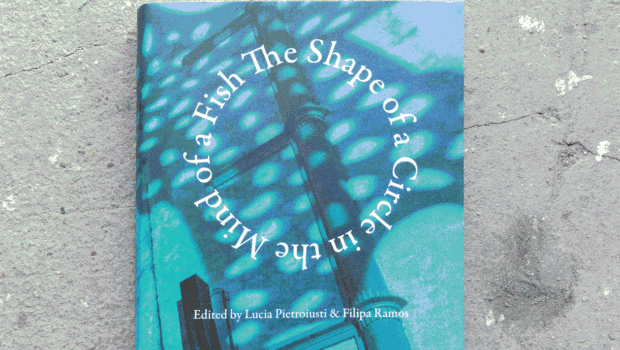
The Shape of a Circle in the Mind of a Fish
Lucia Pietroiusti and Filipa Ramos
|
Getting your Trinity Audio player ready...
|

Dancing with the Fish: An Introduction By Filipa Ramos, Lucia Pietroiusti
At the bottom of the sea, a small, white-spotted puffer fish (which science has named Torquigener albomaculosus) performs a labour of love, making elaborate sand circles, precise in their geometry, astounding in their aesthetics. What shape does the shape of that circle take before it is made? How to understand the movement that constitutes it as a language? How to relate to such a creative expression, a drawing perhaps, but also a dance, made through the body, with pleasure, knowledge, improvisation, and effort, to create something to impress and be shared with others? Most importantly, what is at stake in reconsidering ourselves as a multispecies ‘we’ and acknowledging language, communication, creativity and desire in an interspecies landscape?
In 2018, to launch Serpentine’s General Ecology project, we embarked on The Shape of a Circle in the Mind of a Fish, a long-durational symposium, research and audio broadcast in several parts which, as of 2025, is still ongoing. Over the years, these gatherings have brought together a wide range of thinkers and practitioners from multiple disciplines: from art, literature and architecture to anthropology, environmental advocacy, science and technology. The Shape of a Circle in the Mind of a Fish has pursued the belief that experts in these elds shared certain questions, interests and concerns, and that fruitful conversations could develop between them.
The project was originally intended to explore the porous boundaries between human,1 non- human, animal, vegetal, mineral, fungal and artificial consciousnesses and intelligences. The Shape of a Circle in the Mind of a Fish has since, creature-like, evolved into more than the sum of its parts, however: it continues to participate in discourses that seek, through convening specialisms and ways of knowing, to challenge the fundamental precepts that hold the world in place in all its speciesism, anthropocentrism, environmental degradation and systemic injustice across lives, landscapes and livelihoods.
The first symposium, The Shape of a Circle in the Mind of a Fish, Part 1: Language, took place on 28 May 2018 and brought together choreographers, scientists, artists and writers within the reptile house and auditorium of the London Zoo. Engaging with this space, where complex traditions of spectacle, learning and entertainment have been so profoundly entangled, the encounter acknowledged its situatedness while reflecting on cognition and language in tandem with affect, agency and sensibility across species and beings.
The Shape of a Circle in the Mind of a Fish, Part 2: we have never been one, took place on 1 December 2018 at Ambika P3, a vast concrete hall deep beneath the University of Westminster in London. e title was a playful tribute to Bruno Latour’s germinal study on the anthropology of science, We Have Never Been Modern (1991), displacing it to question the identity of the individual subject and tuning instead into forms of interior multitude, swarm organisms, Gaia theory and collective intelligence, explored across anthropology, art, literature, music, robotics and theatre.
In late 2018, The Shape of a Circle in the Mind of a Fish began to expand into a radio- documentary project and the podcast we began to release behind-the-scenes interviews and in-depth conversations, alongside specially-commissioned sound works, for a Serpentine Podcast series titled On General Ecology, which regularly drew out themes and ideas explored in Serpentine’s ecological initiatives.
The Shape of a Circle in the Mind of a Fish with Plants, the third iteration of the festival, was held on 19 May 2019 at EartH Hackney, London, a restored Art Deco movie theatre in the heart of East London. e event focused on the vegetal world at a moment of the significant emergence of research into plant sentience and agency. is gathering looked at plant intelligence, plant consciousness and communication within the vegetal realm. It assembled natural history curators, horticulturists, film theorists, philosophers, writers, artists and sound recordists, among many others.
In 2020, owing to another other-than-human being, the Covid-19 pandemic radically affected the experiences of working, gathering and producing together. Responding to this context, while trying to envisage modes of staying together, sharing ideas and affects while remaining safe, on 5 and 6 December 2020, we presented a two-day festival entirely online and substantially pre-produced, which we titled The Shape of a Circle in the Mind of a Fish: e Understory of the Understory and held on a purpose-built online platform, themind.sh. Acknowledging our enthusiasm for Richard Powers’ Pulitzer Prize-winning novel, The Overstory (2018), while also wishing to pay our attention to that which remained largely invisible, hidden below the surface of the land, The Understory of the Understory extended the eld of the non-human by questioning the boundaries between organic life and non-life and turning its attention to the soil, the earth and the ground.
Although the discourse of environmental justice had already emerged in previous iterations of the Fish series through non-hegemonic epistemologies and ways of making worlds, this became a far more explicit concern with The Understory. In deciding to ‘take seriously’ (in Elaine Gan and Anna L. Tsing’s terms) a handful of earth and thinking with it as earth, dirt, land, mud and dust, participants and interlocutors in this edition placed themselves in dialogue with the soil in its multiple ramifications; from the microbiological to the geopolitical and everything in between. The gathering, curated in dialogue with the biologist and author Merlin Sheldrake, was also the occasion for the launch of his paradigm-shifting book, Entangled Life. Participants included musicians, ecologists, architects, theologians, anthropologists, poets and soil scientists, among others.
In 2022, the project took on a new international dimension with The Shape of a Circle in the Dream of a Fish, where we worked with artists, architects, ecologists historians, biologists, musicians and philosophers to ask near-impossible questions regarding the consciousness of the self and the possibility of a more-than-human unconscious and dreaming. is edition took place on 26 and 27 November under the majestic, real-sized whale skeleton hanging from the ceiling of the Galeria da Biodiversidade in Oporto, Portugal, which hosts the city’s Natural History Museum, and was presented in collaboration with the Contemporary Art Department of the city of Oporto.
Throughout the series, the artist Giles Round has been undertaking a long-term residence with the Fish project, collaborating with us on conceiving its visual identity and those aspects of art direction and design that cross over into ecological vision and environmental responsibility. Round works across disciplines – including art, design and architecture – through a wide range of techniques and approaches including ceramics, furniture, painting, print, sculpture and sound. Oen taking the form of long-term, open-ended projects in which exhibitions themselves become the medium, Round’s works have at times produced organisations and companies as artworks. rough these, Round creates conceptual frames to interrogate the role of the artist as an agent of transformation. e Fish’s visual identity is part of his ongoing project, The Art Direction of the Noguchi Museum, an enquiry into the role an artist might play as an integral part of institutional and design teams, but also of society’s infrastructures and organisations at large.
When putting together this volume, we moved away from faithfully preserving the chronological order of gatherings, symposia and festivals in print. Instead, we embraced a more holistic understanding of the Fish project in its entirety: acknowledging its spirit and co-evolutions. rough this whole new set of assemblages and cross-dialogues, the book itself becomes a new Fish episode. We worked with participants to identify interventions that – whether they were a script, a transcript, a new paper, or a conversation – best allowed each individual practice to feed into a larger set of worldings; like fragments of a long conversation.
To that end, we elected to re-organise the interventions away from the chronological. They are arranged in several clusters, which are as incomplete and idiosyncratic as any taxonomy. Categories and subject matters overlap, boundaries are porous, titles are subjective, ideas and ways of knowing infiltrate one another.
The first section, titled Worlds, gathers a series of interventions that, in their assemblage, provide an incipient epistemological methodology for the Fish series, which has guided our process over the years. Principles of symbiosis and coevolution, anthropological approaches to more-than-human beings; radical reimaginings of planetary dispositions: all play a part in setting us, and this book, on its course. From there, we may move onto Beings, a section in which more-than-humans emerge as collaborators, co-thinkers and interlocutors – from the sound of a forest stretching and shifting, to the swarming messiness of the soil, through to the body language of animals. Grounds, meanwhile, seeks to ground conversations around more-than-human and planetary life within the reality and socio-political entanglements of dominant anthropocentrism. Environmental justice, as an understanding of multiscalar relations between lives, landscapes and livelihoods, takes centre stage here, though it also belongs to the wider net that subtends the book as a whole. The penultimate section, Odes, brings to the fore the notion of ‘poetics as praxis’ – proposing cosmogony, storytelling and meaning-making as planetary manifestations, and traces of human/more-than-human relationality across deep time. Finally, Oracles closes the book with an open-ended section, where the spiritual realm and advanced technologies (human and non-human) meet at the porous and uncertain edges of planetary computation and that infinite complexity that is so often indistinguishable from the divine.
We never intended to set out a concrete argument through the Fish series. Our aim was rather – and continues to be – reticular and cosmological: to throw a few coordinates out into our shared, known and unknown, space, in the hope that new, three-dimensionalobjects of knowledge, habits of mind, affects and ways of sense-making, could emerge; ones rooted not in transactional, extractive or destructive narcissisms, but rather in attunement, interconnection, embodiment, mutuality and responsibility.
1 Dierent terminologies to dene non-human life will appear throughout the book, according to what feels more appropriate in the context, and to the authors’ own choice.
You can buy the book HERE
Filipa Ramos (Co-Editor) PhD, is a Lisbon-born writer and curator whose research investigates art’s relationship to ecology. She is Lecturer at the Art Institute at the FHNW Academy of Art and Design, Basel, and Artistic Director of Loop, a Festival dedicated to artist’s films, spread out across the cultural and artistic venues of Barcelona. Ramos curated BESTIARI, the Catalan representation at the 60th Biennale di Venezia (2024). She co-founded the online artists’ cinema Vdrome. She runs the art and science festival The Shape of a Circle in the Mind of a Fish with Lucia Pietroiusti, with whom she also curated Songs for the Changing Seasons for the 1. Klima Biennale Wien (2024) and Persones Persons for the 8th Biennale Gherdëina, 2022. In 2021, she co-curated Bodies of Water, the 13th Shanghai Biennale. Ramos was Editor-in-chief of e-flux Criticism (2013–20), Associated Editor of Manifesta Journal (2009–11) and contributed to Documenta 13 (2012) and 14 (2017). She edited Animals (Whitechapel Gallery/ MIT Press, 2016). Her upcoming book, The Artist as Ecologist (Lund Humphreys, 2025), discusses the ways in which contemporary artists embrace environmentalism
Lucia Pietroiusti (Co-Editor) is a curator, programmer and strategist, working at the intersection of art, ecology and systems. As Head of Ecologies at Serpentine, London, Pietroiusti founded General Ecology in 2018 and the Ecologies department in 2023, to further ecological research and experimentation in thought, infrastructure and practice. Pietroiusti is the curator of Sun & Sea (Golden Lion at the 58th Venice Biennale and tour). With Filipa Ramos, she is the curator of Songs for the Changing Seasons (Vienna Klima Biennale, 2024) and Persones Persons (8th Biennale Gherdeïna, 2022). Pietroiusti is a curator of Sites of… Practice (E-WERK Luckenwalde, since 2024), Back to Earth (Serpentine, 2020-22) and Court for Intergenerational Climate Crimes: The British East India Company on Trial by Radha D’Souza and Jonas Staal (2025). Recent publications include More-than-Human (with Andrés Jaque and Marina Otero Verzier) and The Shape of a Circle in the Mind of a Fish (with Filipa Ramos).
©Literal Publishing. Queda prohibida la reproducción total o parcial de esta publicación. Toda forma de utilización no autorizada será perseguida con lo establecido en la ley federal del derecho de autor.
Las opiniones expresadas por nuestros colaboradores y columnistas son responsabilidad de sus autores y no reflejan necesariamente los puntos de vista de esta revista ni de sus editores, aunque sí refrendamos y respaldamos su derecho a expresarlas en toda su pluralidad. / Our contributors and columnists are solely responsible for the opinions expressed here, which do not necessarily reflect the point of view of this magazine or its editors. However, we do reaffirm and support their right to voice said opinions with full plurality.
Posted: August 14, 2025 at 11:31 pm