

Ten Planets
Greg Walklin

Translated by Lisa Dillman
“You know how predictable I find speculative fiction,” Pirg says to Zorg, in one of the stories of “Ten Planets,” Yuri Herrera’s new collection. “It’s formulaic, it’s contrived, it’s adolescent.” Zorg is a lonely, non-human writer, a sort of teenager—despite being 75 years old—who spends a lot of his time “rapturously touching his own tet.” Pirg is more mature, with many more “tets” than Zorg, whom he loves “because she was able to appreciate the importance of stories, especially new or re-newed stories.” She possess a keen critical eye, but has been mostly dismissive of Zorg’s writing. “I don’t really know what you were expecting me to say,” she tells him after reading. But Zorg hopes his new story will change her mind.
One wonders what Pirg would think about the 20 speculative stories in “Ten Planets.” Despite her dismissals of the genre, these speculative stories manage not to be adolescent or contrived. These are, in fact, varied, mature, and imaginative, displaying a range of influence and technique; they struggle in equal measure against both the bounds of typical fiction and the tropes of science fiction. Herrera, from Mexico, is also the author of the novels “Kingdom Cons,” and of “Signs Preceding the End of the World,” which was his first book to be translated into English. He has two other books of stories, as well. All of his fiction has been translated by Lisa Dillman.
Perhaps Herrera’s background—writing in Spanish, having lived in Mexico but studying extensively in the United States—informs the way many of these stories cross borders and involve the mixing of peoples and populations. In “The Earthling,” the difference between Martians and Earthlings is made clear: “Whereas on Earth faces told of desires and of battles lost, faces here were walled off…they appeared and disappeared so imperceptibly as to be almost undetectable….” In “The Monsters’ Art,” captured “monsters” appear to be anything but, while their captors are cruel and actually monstrous. A long history of “The Ones” and “The Others” makes for the main conflict in “The Conspirators.” 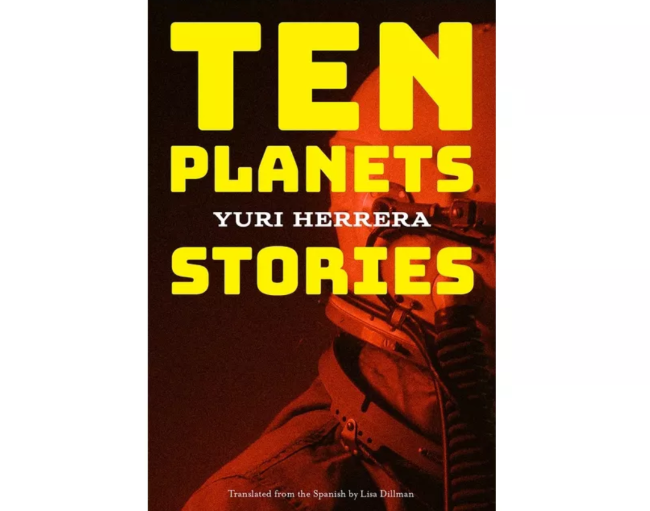
Throughout this collection, tones and styles intermix, as well, especially humor and horror. “The Earthling” begins as a supernatural mystery but ends in ironic laughter; while both “House Taken Over,” a Shirley Jackson-esque tale about a house controlling its residents, and “Inventory of Human Diversity,” about an alien zoo, start as a humorous takes on systems and then transmogrify. But the dominant through line of these stories is subversion. Herrera is careful not to fall into the common clichés of science fiction; he spends barely any time world building, as place has never been one of his big fictional concerns. If other stories, like “The Obituarist” or “Living Muscle” resemble works by other famous writers (Philip K. Dick and Italo Calvino, respectively) it is only in the ways those writers defied expectations and consistently surprised. “The Cosmonaut,” one of the most memorable in the book, mixes the noir of Dick with the some of the vague, religious mystery of Carl Sagan’s “Contact.” Two stories, both named “The Objects,” take different looks at a mysterious, depopulated world.
Surprise animates “Flat Map,” “Obverse,” and “The Other Theory,” which all appear to be connected, but not in obvious ways. In fact, it’s the surprising ways that these stories interact that make them compelling. All are, well, off the map—and it can’t be too often that a science fiction story uses one of the most obvious fictions science has disproven (that the Earth is flat) as the basis for a story. Certainly, Andy Weir would never dream of it.
A lack of surprise, meanwhile, fills out other stories, which approach interesting topics sheathed in ironic, boring bureaucracy. “Appendix 15, number 2: The Exploration of Agent Probii” hides behind its banal title; the story canvasses a planet of people who do not share a language, at least as we think of it, and instead must have different kinds of sex to communicate. Bureaucracy as a motif also appears in “Consolidation of Spirits,” involving the red tape of the spirit world; “The Inventory of Human Diversity,” about a bored zookeeper at an alien zoo; and “The Monsters’ Art,” set in a banally evil facility that keeps supposed “monsters” locked up and confiscates their art. Employing bureaucracies in science fiction plots is not a new concept, but Herrera still makes it feel fresh.
Another refreshing aspect of “Ten Planets” is how the stories can be read politically—but not in a partisan or myopic manner. Herrera has said that “literature always entails a political responsibility,” but should give everyone tools to be a “conscious citizen.” “House Taken Over” warns the reader of letting technology govern our existence, while “The Monsters’ Art” could have been a parable of Hannah Arendt’s. Bleakness lurks around many of the corners in this book, including right from the first story, “The Science of Extinction,” where a man losing his mind isn’t able to fully understand the world ending around him. As it’s not too difficult to read this story as a political allegory, the alarm it raises never quite dies down.
Herrera’s significant strength as a writer lies in his concepts and ideas, and the magical way he creates mood (never better in this volume than in the first story named “The Objects”). What is most interesting about the writing in the English edition of “Ten Planets,” then, is the hurdle of translation. No translation is easy work—but Dillman, for this volume, certainly had to run and jump quite a few times. Herrera’s stories are filled with portmanteaus and neologisms and specific use of Spanish slang. In one of the two stories titled “The Objects,” for example, Herrera refers to an item he calls a “tenmeaqui,” which, Dillman reports in the Translator’s Note, can be used in the same sense as “idiot box” or “pacifier,” in some contexts. Of course, neither “idiot box” nor “pacifier” fit the type of thing in the story—which is a sort of tracking device for people—so Dillman cleverly devised the term “Miniminder” to fill the gap.
Zorg’s approach to writing does a reasonable job of summarizing “Ten Planets.” He writes stories “about fantastical beings trapped in one way or another by bodily limitations, geographical limitations, epistemological limitations: people who were always doing battle and almost always losing but who from time to time managed to break through those limitations and then beautiful things occurred.” When the the little bits of humanity (or whatever “humanity” would mean to a non-human) among all of the exotic worlds and ideas crops up, the book is at its best. It’s Velia’s frantic searching for her man and her daughter in “The Objects.” Or the frantic cries of the human stuck in the alien’s zoo in “Inventory of Human Diversity.” Or Zorg’s excitement at showing his new story to Pirg, which he has dubbed “The Quixote.” Even if this turns out to be mostly a retread of Cervantes, Pirg doesn’t seem to notice. She is too wrapped up, finally, in admiration, which was all he wanted all along.
 Greg Walklin is an attorney and writer living in Lincoln, Nebraska. His book reviews have appeared in The Millions, Necessary Fiction, The Colorado Review, and the Lincoln Journal-Star, among other publications. He has also published several pieces of short fiction. Twitter: @gwalklin

Yuri Herrera (born 1970) is a Mexican political scientist, editor, and contemporary writer. He currently teaches at Tulane University in New Orleans.
©Literal Publishing. Queda prohibida la reproducción total o parcial de esta publicación. Toda forma de utilización no autorizada será perseguida con lo establecido en la ley federal del derecho de autor.
Las opiniones expresadas por nuestros colaboradores y columnistas son responsabilidad de sus autores y no reflejan necesariamente los puntos de vista de esta revista ni de sus editores, aunque sí refrendamos y respaldamos su derecho a expresarlas en toda su pluralidad. / Our contributors and columnists are solely responsible for the opinions expressed here, which do not necessarily reflect the point of view of this magazine or its editors. However, we do reaffirm and support their right to voice said opinions with full plurality.
Posted: November 21, 2022 at 9:41 pm