
Cuba: Selective Aid
Cecilia Borroto López

This is an attempt to make legible for foreign readers a feeling many Cubans share. Our gratitude for the gestures of solidarity Cuba is receiving coexists with a deep unease about how legitimate much of that solidarity really is. What follows is a call to look beyond official discourse and examine the different faces of our nation.
There is a vast gulf between the Cuba of the ruling elite and its acolytes, and the Cuba of ordinary people. Cubans need direct, verifiable aid, not performative solidarity. We are not a trendy topic, a social‑media hashtag, a vintage postcard, or a souvenir to take home; ours is not a fleeting cause to support in order to sleep better at night. We are a country that has faced a humanitarian, social, and political crisis for decades.
For a long time, this Caribbean island has been seen as the last stronghold of communism. It is the “padrino” (political godfather) to whom every left‑wing government turns for approval. It is the utopia many disaffected with capitalism claim to long for. The reality is very different: generation after generation, our people have had their lives squandered in the name of an ideology. Those in power constantly demand more sacrifice from us while they fatten their personal fortunes and reproduce their caste. They approve neoliberal, anti‑popular packages and dollarize the economy in the name of the very people they oppress.
I was born years after the collapse of the socialist bloc, when no illusions were left and it was obvious the crisis would never leave us. Throughout my childhood, criticism was whispered at home or shared only with the most trusted friends. I remember that, from preschool on, they made us march inside the school to demand the return of the child Elián González. Later, the marches were to demand the release of “Los Cinco” (The Cuban Five). Our parents were never informed, even when we were taken out of school for these activities. As an adult, one of my recurring fears is that I may have taken part in an “acto de repudio” (state‑orchestrated mob harassment) without knowing it. It is not unusual to stage these ‘cultural or sports activities’—really actos de repudio—right outside the homes or gathering places of dissidents, bringing children and teenagers there who often have no idea what they’re being used for.
From preschool onward, we had daily “matutinos” (morning assemblies) loaded with political and ideological content, always ending with the slogan: “¡Pioneros por el comunismo, seremos como el Che!” (“Pioneers for communism, we will be like Che!”). We learned to read and to do sums with textbooks about militiamen, victories, and the defense of the homeland. On television there were only two channels, and almost every day a speech by Fidel Castro, plus other programs designed to reinforce indoctrination. I dwell on this to show how the schooling of Cuban children, teenagers, and young people has been shaped: saturated with slogans that each day represent fewer and fewer of us.
Currently an international campaign is underway to support what many consider ‘Cuba’—from Hollywood artists to members of left-wing parties and organizations across half the world. Why question the legitimacy of this support, even when many people join in good faith? Because it is selective. Because our matria (motherland, homeland seen as maternal) did not start suffering last month, when the United States blocked fuel shipments; that only accelerated the collapse. The financial aid the regime receives is not audited, and there has never been a real possibility of knowing where each cent, each shipment of supplies, ends up.
Under a 2016 agreement, France has donated millions of euros over several years for sectors like health and agriculture. Russia, under a deal approved in 2015, granted 1.2 billion euros to build thermoelectric plants that were never built. Cuba’s now‑chronic energy emergency is due precisely to the failure to invest in new technology. The European Union allocates millions in donations to health and local development without any transparent traceability of the funds. In 2019, it donated 300,000 euros for humanitarian aid to those affected by a tornado, and similar amounts after hurricanes. Yet ordinary people have never found out how that money was used, and the health, education, agriculture, and energy sectors are ever more depleted.
Many of those who now raise their voices with “Hands off Cuba” have never spoken out against the systematic violation of Cubans’ rights. Where was today’s outraged international community each time Cubans took to the streets to demand basic rights like water, electricity, and food, —or above all, freedom—and were then imprisoned?” Where were they when Díaz‑Canel said on live television: “la orden de combate está dada” (“the order to fight has been given”) against the July 11 protesters?
Cuba has more than a thousand political prisoners, and every few weeks the number rises. One of the latest cases was the arrest of Ernesto Ricardo Medina and Kamil Zayas Pérez, influencers behind the podcast “El 4tico”. But this repression of dissenting thought has been going on for many years: the “Primavera Negra” (“Black Spring”), those imprisoned after the July 11, 2021 protests (11J), the protests in Bayamo, in Encrucijada, and so on. The repression does not only target demonstrators; it extends to their families, and examples abound. There is the harassment of Wilber Aguilar, father of Walnier Aguilar, a young 11J protester who also has an intellectual disability. There is the harassment of the parents of the Perdomo brothers, both 11J protesters. Jorge and Nadir Perdomo, to make things even worse, have been sent to different prisons in a country where there is practically no transportation.
One of the most wrenching cases is that of journalist José Gabriel Barrenechea, jailed for peacefully protesting alongside the people of Encrucijada. His mother, Zoila Chávez, was an 84‑year‑old cancer patient who depended entirely on her only son. Despite her pleas to the government to be allowed to see him as her illness worsened, the regime refused. That refusal held firm even after many Cubans signed a petition in favor of the desperate mother. Zoila wept and begged for her son until the day she died. Only then, and under heavy police guard, was José Gabriel allowed to see his mother’s body.
There are many more families shattered like this; every story of a political prisoner tears at the nation. Readers can find more information on the websites of organizations such as Justicia 11J (Justice 11J), Prisoners Defenders, and Amnistía Ya (Amnesty Now).
Foreign left‑wing movements that today rally “for Cuba” seem unaware of how openly anti‑popular Cuban state policies have become. Especially since 2008, long before Donald Trump entered the political arena, newly appointed Raúl Castro put in place a model based on cutting subsidies, shifting social spending onto the shoulders of the poorest families, dismantling the social‑security system, and slashing investment in sectors with enormous social impact such as health, education, and housing. As the State has shed its social responsibilities, poverty, inequality, and the abandonment of already precarious groups—older people, large families, retirees, and pensioners—have only deepened. When social protest has confronted this reality, the repression has been open and brutal.
Those who are only now protesting because of Donald Trump’s restrictions on Cuba never showed solidarity with victims of “actos de repudio,” with the “desterrados” (those actively expelled from their homeland), or with the exiled. They ignored the mass, violent “actos de repudio” against those who left via the Mariel boatlift, those now organized against activists, independent journalists, or anyone who dares dissent, and the nationwide TV programs that routinely smear and morally lynch dissidents without right of reply.
Power in Cuba does not just produce exiles; it also banishes citizens, while denying them any document that proves their “destierro.” Some current cases are those of Anamely Ramos, Omara Ruiz Urquiola, and Leticia Ramos. Omara, a cancer patient whose treatment had even been suspended in Cuba, is pressured through actions targeted at her 76‑year‑old mother, who remains on the island.
Both Omara and Anamely, two respected intellectuals and professors, have been prevented from boarding flights to their own country. What happened to Leticia Ramos, however, reveals an even more sadistic streak. She is a member of the ‘Damas de Blanco’ (Ladies in White), women who have long demanded freedom for their imprisoned relatives, especially since the “Primavera Negra”. She actually landed in Cuba, but immigration authorities denied her entry and immediately sent her back to Miami. She was not even allowed to say goodbye to her elderly mother, also a Dama de Blanco, who was traveling with her.
Those scandalized by Trump-era policies have never questioned a regime that sank the tugboat “13 de Marzo” in 1994, killing 41 people including 10 children. Nor one that ordered the sinking of the “XX Aniversario” vessel on the Canímar River in Matanzas, where 56 people died—20 of them children. Nor one that destroyed a boat in Bahía Honda, killing at least six adults and a two-year-old girl her mother couldn’t hold onto. Be coherent: denounce everything, not just what is “politically correct” or fashionable because of its geopolitical visibility
Cuba needs help, and has needed it for decades. It needs visibility, and it needs the world to recognize the tyranny that is suffocating us. We are an impoverished country, deprived of individual and collective freedoms. The blockade, the embargo—call it what you will—has caused harm, but the worst blockade is the one imposed by those in power on their own people.
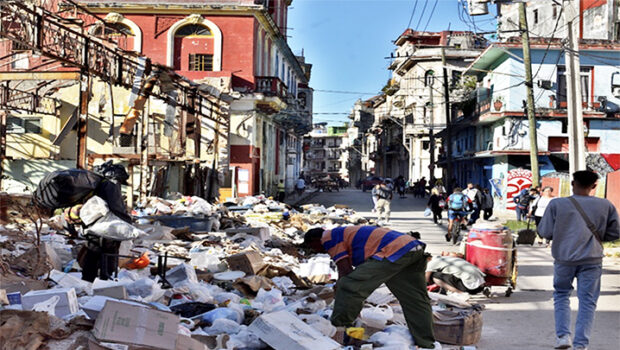
Cuba is not in crisis today because the United States blocked access to oil. Cuba has been in a deep humanitarian crisis since the covid‑19 pandemic. This is not only due to the pandemic itself, but also to the government plan known as “Tarea Ordenamiento” (Ordering Task), and to the decision to prioritize hotel construction and the modernization of the repressive apparatus over health care and education. There is no money for ambulances or buses, but there is money for new patrol cars, motorbikes for the traffic police, and anti‑riot units like the ones deployed on 11J. There is no fuel for thermoelectric plants or public transport, but there is always fuel to repress citizens. In Cuba’s provinces, blackouts have been daily for two years, lasting at least twelve hours. Over the last year, in many places there have been only one or two hours of electricity a day. We are being killed slowly, and without mercy.
Cuba is not an ideology; we are a people condemned to suffer so that part of the international left can feel there is a safe harbor somewhere. The supposed utopia of Cuban socialism is a lucrative fraud for the dictatorship, which uses the population as hostages to increase its income. Support is always appreciated, but it must come from a place of genuine social conscience. Do not support the regime just because it proclaims itself “left‑wing”; support by thinking first of people, not of ideology, and not simply out of opposition to Donald Trump or to imperialism.
Help us, but help us consciously; show solidarity with the people, not with the dictatorship that crushes us and uses us as bargaining chips. Cubans on the island are held hostage so that the relatives who were forced to leave can keep the ruling caste afloat. Family comes before everything, and the regime weaponize that fact.
Do not use us as a flag for any ideology. Make a difference: listen to the people in all their plurality. We are not ungrateful; what we ask is that the gaze turned toward Cuba not be superficial. What we ask is that it be deep, and just.
Cecilia Borroto López. She holds a B.A. in Education, with a specialization in Spanish and Literature, from the University off Matanzas (Cuba), and an M.A. in Spanish with a Concentration in Literature from the University of Houston. She is currently a Ph.D. student in Spanish with a Concentration in Literature at the same institution.