

The Elementary Forms of Corruption: Moral Imagination and Political Change in Brazil
Aaron Ansell
|
Getting your Trinity Audio player ready...
|

The Politics of Fathers
In 2004, years before my friend Zezinho died of liver failure, his nephew defeated him in an election for the presidency of his village’s governing association. That didn’t surprise me. I had been living in the house next to Zezinho’s for several months, trying to help him cajole his fellow villagers into participating in a community development project introduced by the new PT (Workers’ Party) government—and it wasn’t going well. What did surprise me was that later that night, Zezinho insisted to me that his nephew, through his very candidacy, had “done a corruption” (fez uma corrupção) against him. Why would he frame his nephew’s actions in such terms?
This question is central to the goals of this chapter because it suggests that the folk model of corruption guiding Zezinho’s remark differs from the transnational, Enlightenment-derived corruption model based on the distinction between public and private spheres. Zezinho’s grievance with his nephew made no reference to any “misappropriation of public resources for private gain,” as corruption is typically defined in the Western tradition (Fukuyama 2014: 83). Instead, Zezinho’s grievance emerged from a patronage model of social organization, a social order based on the values of good fatherhood and the rightful channeling of moral currencies to respectful “children” (literal and metaphorical). Once again, none of this was clear to me at the time. To my eyes, the village election was just a healthy exercise in the rotation of power, democratic decision-making, and so forth. And anyway, the stakes seemed low; the presidency was an unpaid and often thankless position that few people wanted.
Over the next few days, Zezinho would complain to me that his nephew had cheated by enrolling new families in the village association, families living outside the village who nonetheless wanted to partake in the PT’s development project. The idea was that the nephew would pay their membership dues for a while if they would vote for him.[i] So, I asked Zezinho
Aaron: Is that what you meant when you said he did corruption against you?
Zezinho: No, no. That is to say, yes; it’s all part of it.
Aaron: But what did you mean? I don’t understand.
Zezinho: How can I explain …
Zezinho’s explanation began with the seemingly unrelated complaint that for several weeks, his nephew had “passed me on many mornings and never asked my blessing.” It took me some time to sort out the connection between Zezinho’s complaint and his allegation of corrupção.
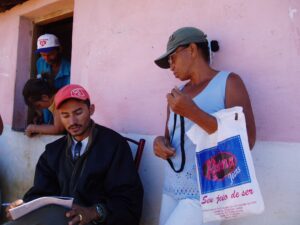
Throughout much of Northeast Brazil, it is the responsibility of all decent people (gente decente) to greet kin from a senior generation not with words like “hello” or “good day” but with the one-word request, “Blessing?” (bença). People often said it with a slight bow and their palms outstretched, facing upward: “Blessing, Father?” “Blessing, Uncle?” “Blessing, Grandma?” “Blessing, Father-in-law?” “Blessing, Godmother?” The senior kinsperson completes their part of the greeting ritual (also sometimes a farewell ritual) by lifting a hand heavenward and saying, “May God bless you.” Sometimes, instead of lifting their hand, they place a downward-facing palm over the junior person’s upward-facing palm while bestowing the blessing.[ii]
Writing of his childhood in the Northeast, the Brazilian novelist, Luiz Sávio de Almeida, attests to his unfailing solicitation of the blessing each day: “from my grandparents, uncles/aunts, and godparents, people who the family relation sacralized … like a family priesthood (sacerdote) … I thus honored the chain of life seated in these people” (Almeida 2006: 145, quoted in Ansell 2018: 26). Almeida’s metaphor of the downward hanging chain of life (cadeia de vida), with each link serving as a discrete gradation of one’s proximity to God, nicely captures Maurice Bloch’s ([2007] 2015) neo-Durkheimian assertion that individuals achieve completeness only in relation to one another, that is, only by interlinking with one another (“going in and out of each other’s bodies”). Here Almeida puts rhetorical emphasis on the junior kinsperson’s (his own) dutiful moral posture (“unfailing solicitation”) towards senior kin, which he reanalyzes in terms of how this solicitation reinforced (“honored”) this explicitly sacred gerontological gradient.

Right-wing federal deputy and presidential candidate Jair Bolsonaro, gives a thumbs up to supporters during a rally at Afonso Pena airport in Curitiba, Brazil on March 28, 2018.
Bolsonaro, who has repeatedly praised Brazil’s two-decade-long military dictatorship, taunted Lula, calling him a “bandit,” and challenging him in Curitiba to see “who can get the most people out on to the streets without paying them.” / AFP PHOTO / Heuler Andrey (Photo credit should read HEULER ANDREY/AFP via Getty Images)
Implicit in his account (but more explicit among my field informants) was the downward-flowing movement of divine blessings across this gradient. Down the “chain of life” flows the divine grace that is never taken for granted in the drought-afflicted sertão, as sertanejos attest when they claim that they need their seniors’ blessing to “open doors” for them, that is, to open up opportunities for them to gain ground in their jobs, health, love lives, etc. Sertanejos often say that “without God, we are nothing,” a phrase indicating that what people need to perpetuate their families and communities (e.g., rainfall, the fertility of crops and livestock, sexual virility, the survival of birthing women and their newborns) will come only to those who submit to a cosmic order whose guarantors are senior kin. When seniors give junior kin their blessing, they essentially channel God’s moral currency down the line of generations.3[iii]
[i] The practice Zezinho describes is similar to a common electioneering trick found throughout the sertão. It goes like this: A municipal candidate secures additional votes by paying (or promising favors to) residents of a neighboring municipality to change their official address to the candi- date’s municipality and then to vote for the candidate. The legitimacy of this practice is hazy. The voters in question may have family (usually par- ents) living in the candidate’s municipality and may even live there them- selves for part of the year in conformity with the agricultural calendar.
[ii] Elsewhere, I offer a fuller discussion of sertanejo family blessings in which I argue that one effect of these blessings—those occurring between rival politicians who are kin to one another—is to perform a kind of civility that “brings into being … a public sphere with liberal attributes” (Ansell 2018: 23).
[iii] At another level, the blessing ritual has become an emblem of the sertão itself, of the region’s quaint traditionalism, something that gives visceral density to the feeling that the sertão is the authentic Brazil; the locus of the nation’s sweet and welcoming character, superstitious piety, and rugged vitality; “the vigorous core of our nationality” (Cunha [1902] 1944); and the site of Brazil’s “deepest wounds” (Rogers 2010). Thus, to engage in the appropriate blessing behavior is to perform one’s authentic embodiment of rustic traditionalism, and to forgo the blessing is to associate oneself with the modern temptations of Brazil’s cities (drugs, sex, and crime), to abandon the sertão and one’s “family priesthood.”
This is an excerpt from Chapter 1. HAU Books. Copyright: © CC BY-NC-ND 4.0. Published by HAU Books.
The book is available here
 Aaron Ansell is Associate Professor of Religion and Culture at Virginia Tech, and author of Zero Hunger: Political Culture and Antipoverty Policy in Northeast Brazil.
©Literal Publishing. Queda prohibida la reproducción total o parcial de esta publicación. Toda forma de utilización no autorizada será perseguida con lo establecido en la ley federal del derecho de autor.
Las opiniones expresadas por nuestros colaboradores y columnistas son responsabilidad de sus autores y no reflejan necesariamente los puntos de vista de esta revista ni de sus editores, aunque sí refrendamos y respaldamos su derecho a expresarlas en toda su pluralidad. / Our contributors and columnists are solely responsible for the opinions expressed here, which do not necessarily reflect the point of view of this magazine or its editors. However, we do reaffirm and support their right to voice said opinions with full plurality.
Posted: August 27, 2025 at 8:50 pm