
Too Much Text
Catalina Infante Beovic
|
Getting your Trinity Audio player ready...
|
Translated by Michelle Mirabella
My work is writing—I write for media outlets, I write my own books, I write books credited to others, and lately I’ve been seeing this feedback: “Too much text.”
In fact, as part of the comments I got back on a book that I’m ghostwriting, TLDR was written on one of its pages. A photography book, which by the way, has very little text. I’ll admit I actually had to google it because I’d never seen or heard of that initialism before. TLDR means too long; didn’t read, in Spanish that’s demasiado largo; no lo he leído, internet slang for when a text has been wholly ignored for being too long. But let’s define long, because we’re not talking War and Peace here. Long was four paragraphs in a row. According to Wikipedia, the initialism is also used to ask whoever is writing, if they’re writing something “long,” to help the reader out by including a one-line summary: “Please include a TLDR.”
Since when has twenty lines in a row become so hard for us to read?
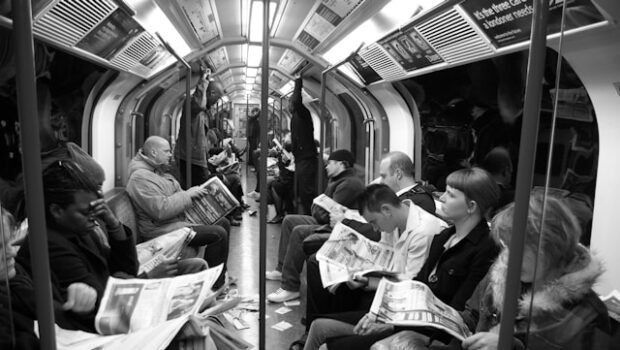
We’re also seeing this in online journalism (if print journalism can even be said to exist anymore). Click-baiting templates are built on reducing word counts and breaking texts up as much as possible, filling articles with words in bold, subheadings, photos, and every visual resource under the sun to ensure the reader doesn’t lose steam or lose focus when surrounded by so many words. Writing “too much text” is no longer an option, so journalists are out there attempting to grab the attention of their easily distracted audience so as not to wind up reader-less, jobless. In short, both writers and readers live subject to the “dictatorship of clickbait,” where a clickbait-y title like “Earth Under Threat of Meteorite Strike in 100 Years” or “French Fries Cause Depression” is followed by a sensationalist lead that hints vaguely at everything but says nothing at all and then ends with an article full of flowers and fireworks that, despite saying so little, clings to the idea of someone reading until the end. The problem is that hardly anyone does. We read the headline, the lead, and then scan the article, engaging halfheartedly so our takeaways wind up lacking, only partially true, and so unsatisfying—like eating a rice cake for lunch.
Not all journalism is like this, that’s true. We still have investigative journalism, crónicas, columns, and op-eds where an appreciation for uninterrupted text carries on. While it’s true we can still read a literary column by Leila Guerriero, between articles on meteorites and French fries, media outlets are riskily embracing these shortened, fragmented formats because their funding depends on clicks. And in the thick of a crisis where there are fewer and fewer spaces for writing, this disjointed approach that’s full of confetti threatens to push the “TLDR” texts to niche websites where, essentially, those who are actually doing the reading are the same people who are doing the writing.
OK, literature and literary journalism may always have their place, but readers don’t live for literature alone; news, crónicas, articles on science and history, don’t they too deserve to be lengthy, fluid, deliberate, well-researched, and well-written texts? Because unless we’re talking about poetry, micro stories, a flyer posted at the market, or newspaper headlines, an extreme economy of language robs us of meaning, experience, and knowledge. We seem to be treating texts as if they’re images; we quickly scan the page and look for two or three takeaways that hopefully come underlined and with enough breaks throughout the text to rest our eyes.
A good way to wind up reading air.
We’re not just seeing this in journalism, because those of us who are writers are now getting hit with this refrain when writing books, like the TLDR I got for writing three paragraphs. Of course it’s not everyone, but let’s be honest: publishing houses and readers today are looking for light reads because we’re short on time and have limited attention spans, and because we’ve gotten used to the pacing of social media and clickbait. For that reason, we see a lot of autobiographies, non-fiction, and self-help books following suit, to be faster reads that keep their audiences engaged. They’re also written as light reading, and they’re getting lighter and lighter. Consider how there’s now an app where you can upload a book in pdf and ask for a two-line summary. I’ll admit, I did it once; I was feeling so lazy about reading the book that I fell prey to the temptation and ease, and I’m short on time and full of contradictions. We—I now include myself—want something light to read because there’s no time, because by the tenth line I get distracted, bored, I open TikTok, head to the kitchen to make a coffee, and then forget to pick up where I left off or decide not to, because I’ve convinced myself that I only needed three lines in bold to get a general idea of what the text was trying to tell me. Why read the whole thing if I can ask a robot, the famous TLDR.
But not everything can be trimmed down to two lines.
At the end of the day, what do we get from that kind of reading and how long does it stay with us? Perhaps I’m exaggerating and I’ve finally become the old lady who criticizes the actions of younger generations, calling them lazy. Even though I include myself as lazy because, in my work as a journalist, I’ve been directed to write using subheadings, highlighting and including links and pictures, and I’m growing more and more used to reading the news that way. However, literature will always be there for me. But, in a way, I’m grieving how texts have begun to tire our eyes, I’m grieving this new approach to writing where you trick the reader, setting traps so they don’t realize what they read, so they don’t burn out. Lighten up that content, until it becomes so splintered and ethereal that it lingers only for a moment.
Frankly, I wonder if anyone has even read up to this point.
 Catalina Infante Beovic is a Chilean writer, publisher, and co-owner of Librería Catalonia in Chile. She has written three books of stories of the indigenous peoples of Chile with Sonia Montecino, anthropologist and recipient of the Chilean National Social Sciences Award. She made her English-language debut in 2020 with the short story “Ferns,” which was nominated for a Pushcart Prize and adapted into film. The Cracks We Bear is Infante Beovic’s first full-length novel translated into English.
 Michelle Mirabella is a Spanish-to-English literary translator. In addition to her translation of Catalina Infante’s debut novel, The Cracks We Bear, her work appears in the anthologies Best Literary Translations (Deep Vellum, 2024) and Daughters of Latin America (HarperCollins, 2023). A former ALTA Travel Fellow, Michelle holds an M.A. in Translation and Interpretation from the Middlebury Institute and is an alumna of the Banff International Literary Translation Centre and the Bread Loaf Translators’ Conference. Find more of her work at www.michellemirabella.com.
Foto de Peter Lawrence en Unsplash
©Literal Publishing. Queda prohibida la reproducción total o parcial de esta publicación. Toda forma de utilización no autorizada será perseguida con lo establecido en la ley federal del derecho de autor.
Las opiniones expresadas por nuestros colaboradores y columnistas son responsabilidad de sus autores y no reflejan necesariamente los puntos de vista de esta revista ni de sus editores, aunque sí refrendamos y respaldamos su derecho a expresarlas en toda su pluralidad. / Our contributors and columnists are solely responsible for the opinions expressed here, which do not necessarily reflect the point of view of this magazine or its editors. However, we do reaffirm and support their right to voice said opinions with full plurality.
Posted: September 11, 2025 at 9:42 pm