
Come From Nothingness
Adriana Díaz Enciso

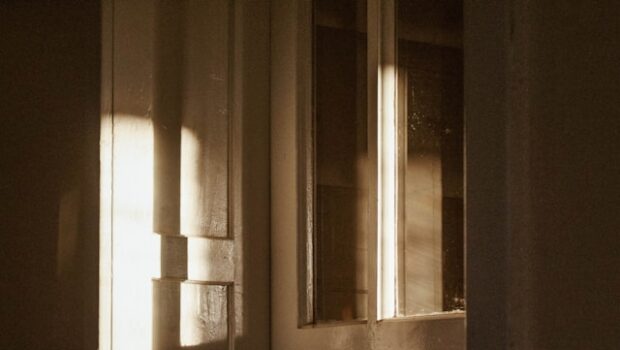
A limpidity of light, already there before your eyes are opened. Lucidity not an attribute, but substance. Something that is—unnameable, ungraspable, and what it is is reality. The revealed and the revealer, and you in its midst. How it spread its domain in all directions, how exactly the thaumaturgy worked—the surreptitious transit from the dark velvety unknowingness that was the known world where you fell asleep to this silent dazzle, gentle, portentous, a kind of violence—you cannot know. That it happened while you slept, the two of you, side by side, and none of you noticed, none were alive to it to discern its gradations. That it crept in while you strayed through unshared dreams that your morning words, still slow with slumber, would feebly endeavour to describe, leaving you both wondering; that, without any ostensible concern for you or him, for flight-crazed bird or stained chipped roof tile or naked branch it brought out shapes and colour; that it swelled without volume, grew without dimensions to become the unseen and yet sensed gold where you awoke at last is so big a wonder that, in a sudden urge to praise, you forsake language. You sink upwards. An elevation towards the source; an endless fall in awe. Not downwards: boundless, expansive. And therefore no fall at all.
There is wind out there, you notice, its substance invisible yet manifest in that quivering bush still holding on to its leaves; in the awning’s seabound billow, that woman’s hair flitting against her face like the unheeded reminder of something she doesn’t know, something she forgets to question as she stares into the immaterial light, as if bewildered, momentarily distracted from the everyday concerns of her small human existence, her eyes so bright facing the sun, glass-like and empty, like a cat’s. Wind and deep blue sky, and though you can’t see the wind, today it is, in a way, bright. You will look up, the two of you, thus conjoined, thus contained, wondering without words or indeed thoughts at the randomness of clouds, their soundless whisper, their playful transit, their light melancholy—they share in the nature of ghosts—and that airplane’s contrail, sheer white against the distant blue, the boundless sphere that holds you and everything that is. As if someone were painting the sky.
You have been thinking of death; its full command. An incongruous palm tree in this winter city scene shakes its mane wildly by the roundabout, as if telling you something, or rather calling someone who’s not you, or anyone—calling with its tree voice, its object voice, voice of a created thing asserting its reality. Signs that you can’t unravel. Like the flock of childhood memories, there, just out of your field of vision, about to be set loose like the pigeons that fly so gloriously in eternal circles, who live their days for food and light only. You yourself feel like a sigh.
Death, so hard to conceive, though you know it so near, so near… Unformed but striving to take shape, invisible and yet dark wisps of nothingness, contorting no-matter writhing on the margins of your breath, a grey kaleidoscopic absence of substance in a spin of unbecoming. You fear death as emptiness in the sense of ‘hollow’, and even in the Sunyata meaning that constitutes the background of your longing. But in truth it is extremely difficult to conceive of death like that, and therefore your fear is forged. You think of your dead and can’t see emptiness anywhere in or around them—only the veil; the mesmerising, silent movement of their hands signalling behind it. You wish to believe it’s a deeper being (is Sunyata a deeper being? Being beyond being, and certainly beyond becoming. Ultimate being and its myriad opposites, its misleading reflections, amalgamated into that which lies beyond expression and cannot therefore lie anywhere). But how can a deeper being have anything to do with such abstractions. No. It must be, you think, like this light. That’s it: death is this light. Or the other way round. Death like this stilled keenness, eyes still living facing the radiant mesh of wonder, its moving reflections, beauty without owner, without creator, without meaning bathing—no, permeating—the world, and you speechless, unable to lay your hands on any single part of it; the whole world tongue-tied, tongueless, not a single shard of human articulation that can bind this eternity of light to the darkness that will soon (very soon) engulf the winter day again—that gloomier, hopeless intimation of death, a dire transmutation of the visible that you can only know because you’re living.
To wake in this light, the two of you, naked and mortal, held in this discernible silence. The force of love travelling like a potion through your veins, his veins, twinned to your knowledge that you too shall die, and contained in this lucent sphere, wholly immaterial, as if in your embrace you were both made of ice, or crystal, while the wings of pigeons, seagulls, all sorts of creatures of the air shining outside like glints of silver swiftly crossing your window are—you know it, holding your breath—eternity. Is it something like this then, the nothingness you come from, long for?
Or let us put it this way: waking to yet another such day, pristine light, which within you is the same day, same timelessness. A minute, gleaming pellet of joy, the joy measured not by the smallness, but by the exactitude of its baffling presence. Its perspicuity. How it expands without growing, without abandoning that close place within where it is nesting. The place that prompts you to ask, maybe aloud, How can the world be so beautiful? You’re filled with light. That is to say, you’re empty; no place for the self in you in that luminous dimension that grows both inwards and outwards, without crossing any perceptible barrier. There is only light, and the crows flying in pairs, in circles, drunk with delight high up around the top floors of the hideous grey buildings which this morning aren’t at all hideous—they aren’t even buildings, properly speaking, but vast reflections of light, of the blue, blue sky. The crows’ wings are glistening, clean, the sharpest black. They disappear behind the crystal panes and come back again, still the same pair, still in their spiral flight, an embroidery of invisible threads, a drunkenness. They perch for a moment on the pale bare branches of a slender tree and then take off again. Below, other trees laden with clusters of red berries, and standing there in the cold air, in the midst of rapture that is not so much yours as the rapture of the sky, of the crows, the red berries and the innumerable reflections, you wonder if there was perhaps such light, so long ago and so far away, in a land you may never see again, on the day you were born.
You board the bus as if inside a dream; you drift along the curves on the road, half reading Faith, Hope & Carnage, half looking out of the window, still dazzled, pages and view somehow the same thing, the ice sculpture melting in the sun*, that odd shining stone in your heart whispering in light: Yes, it is like this. And suddenly an image rises—from where, you do not know—of you as a child in the garden. It’s not just inside you, and it’s more than a memory. It expands, it is somehow in the day, in the sky, the light all around, pervading the very reality of this moment, and you wonder what is the bond that couples both specks of time, what relation is there between the child and the woman, and whether, since this is not a mere memory, it isn’t so much a matter of the older woman who thinks of death suddenly looking into her past, but of the child in the garden, on a bright day far, far away, living through some prophetic moment, anticipating what would come to be—which is light, and only light.
* From the lyrics to “White Elephant”, by Nick Cave, alluded to in the book Faith, Hope and Carnage
Foto de Anca Luchit en Unsplash

Adriana Díaz-Enciso es poeta, narradora y traductora. Ha publicado las novelas La sed, Puente del cielo, Odio y Ciudad doliente de Dios, inspirada en los Poemas proféticos de William Blake; los libros de relatos Cuentos de fantasmas y otras mentiras y Con tu corazón y otros cuentos, y seis libros de poesía. Su más reciente publicación, Flint (una elegía y diario de sueños, escrita en inglés) puede encontrarse aquí.
©Literal Publishing. Queda prohibida la reproducción total o parcial de esta publicación. Toda forma de utilización no autorizada será perseguida con lo establecido en la ley federal del derecho de autor.
Las opiniones expresadas por nuestros colaboradores y columnistas son responsabilidad de sus autores y no reflejan necesariamente los puntos de vista de esta revista ni de sus editores, aunque sí refrendamos y respaldamos su derecho a expresarlas en toda su pluralidad. / Our contributors and columnists are solely responsible for the opinions expressed here, which do not necessarily reflect the point of view of this magazine or its editors. However, we do reaffirm and support their right to voice said opinions with full plurality.
Posted: March 24, 2026 at 9:02 pm