
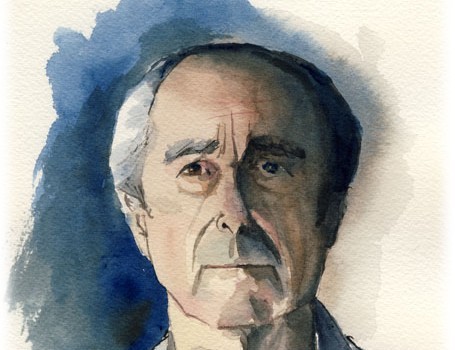
Philip Roth: The Struggle With Writing Is Over
Sven Birkerts

The Relation Between Writer and Material, Volition and Production.
Philip Roth has said he is done with writing. He told an interviewer for a French journal. It was not an announcement as such, though it might as well have been, for within days it was all over the media. No more writing. It was a smart gambit, for to actually announce such a thing would be to appear to presuppose the world’s interest in the news, which of course does exist, but still, one does not want to presume. In a subsequent New York Times interview with Charles McGrath, Roth tells of a post-it note affixed to his computer. It reads: “The struggle with writing is over.” Now that he has made his decision, he looks at the note every day. “It gives me such strength,” he says. We can only be glad–if not for ourselves, then for the writer who gave so much for so many years. Any other response would be ungrateful. And yet.
And yet somehow I feel that things don’t quite line up here; it’s not so simple; there are questions. The main one, front and center, has to do with agency. Roth has stated that he will no longer carry on something that had finally become for him such a struggle. What makes writing a struggle, of course, is that the writer cannot control the process–neither the access to the material, nor the quality of the output . “I know I’m not going to write as well as I used to,” he says. “I no longer have the stamina to endure the frustration…I can’t face any more days when I write five pages and throw them away.”
What is the relation between writer and material, volition and production? Roth affirms, interestingly, that he did not come to his decision with immediate finality; that for a long period he waited and watched. He did not want to be precipitous. But nothing came. And as any writer knows, when there is nothing, or little, or even simply not enough, the process is excruciating. To sit at the desk at such a time is to come face to face with inadequacy–the discrepancy between desire and the possibility of its realization.
So Roth has stopped–though he also knows that where creativity is concerned, the game is open. “I was wrong! I had no idea that there would be more!” In these matters volition is largely illusory. The artist is a vessel for energies and impulses not fully in his control. But at the same time, he is invested: those unpredictable energies and impulses seize upon the artist’s personality and life-experience as material. As Roth puts it to McGrath, “I needed my life as a springboard for my fiction. I have to have something solid under my feet when I write. I’m not a fantasist. I bounce up and down on the diving board and I go into the water of fiction. But I’ve got to begin in life so I can pump life into it throughout.”
Given the intensity of the connection between his experience and his art, what does it mean for a writer like Roth to say he has decided to stop writing–as if doing it or not doing it were somehow subject to volition? Roth is making a wager: that there will be no more of the old lifts of inspiration. If, as expected, nothing comes, then he has spared himself the grief of wanting and not getting: he has not won anything–but he has not lost. And if he finds, one day, a rush of writing energies, then he is free to retract. “I was not expecting this…” Who will gainsay him?
But as I said. there are questions. For instance, does the decision to stop in any way short-circuit the possibility of new material? Has he also made the decision–if such can be made–to stop thinking like a writer? To stop thinking like the man he is? And what is the inner life of a person who has consciously elected no longer to look at experience as material that might be turned toward artistic ends–who looks without imagining the possibility of transformation? Can a leopard change its spots? Can a writer ignore what made him who he is, the formation of his origins? Or, if not ignore it, change it?
What is writing that one could stop it? Is it something that can be isolated and acted upon? I believe, to the contrary, that in a writer the writing consciousness is essentially identical with consciousness itself. Even more than what he produces, it is what makes him a writer. What I draw upon in order to write is the full perceptual awareness of my day to day living. But it’s not that I experience my life and then draw upon it in order to write. Rather, I carry out much of my living through the mentality–the identity–of writing.
To imagine saying ‘enough’ to writing is to imagine no longer inhabiting that mind-state–to imagine, in effect, no longer being myself.
I’m not saying that I consider everything that befalls me as subject matter or potential material, not by any means, but I do believe that everything is at least in some way perceptually informed by that awareness, that sees experience not as dead-ending in its moment, but as ever liable to being recouped, remade through imagination. Such seeing has become second-nature. I come out of the post office and notice a man fidgeting by the curb, waiting to cross the street. He is wearing a blue baseball cap and a pair of running shoes, and the way he leans forward, looking this way and that, tells me that he is going to jog to the other side as soon as there is a break in traffic. Observing him, I have assessed him. And if writing is at the deepest of levels a desire to repossess the whole of experience through structures of language, then the man in the cap is a very small but real part of that whole.
* * *
The difficulty of writing comes on so many levels. To begin with, there is the insistence–every writer recognizes this–on style, on the making of sentences that feel fresh and compelling, that do not reiterate prior versions of the self. Here the challenge-gradient steepens with every passing year. Not only is the long-term writer always in danger of overusing–wearing out–his core material, but avoiding stylistic repetition also takes real work. So much of what we put to the page is haunted by familiarity. The circuits are inscribed–by us. How readily we go to the familiar prose rhythm, and how hard it is to write otherwise without at the same time seeming deliberate.
Then there is the matter of creative energy. Any writing that hopes to stick to the page requires an intense originating pressure. Pressure of attention and focus, pressure of language–verbal originality–and a sense of larger consecutive coherence, and intent, that is rarely achieved without a strong infusion of creative élan vital. Good writing is the product of desire–one writes well because one needs to get something said and is able to command the necessary, and demanding, resources of craft.
To talk about the writer in decline is to talk about style. There is the failure of language to match intent, or–worse–the inability to clearly isolate the intent. I don’t know that we can plot this ascendancy and diminution clearly on a curve. In many cases that it’s less a matter of a single sweeping arc than of an extended pattern of fluctuations. I know that I have often hit periods where it seemed I would never again find a sound that felt right, necessary, and then I have surprised myself, suddenly finding a tone and subject that correlated, that worked.
Still, the business worries me deeply–that my central occupation, my obsession, the focus of my ambition since my teen years, might be subject to a fading; that I could lose energy and inspiration. I remember so clearly the feeling of the periods, years and years, when neither subject nor style were subject to question or doubt–when, full of ambition, I wrote whenever I could, every day, producing my pages with a confident regularity that now astonishes me. I cannot now imagine putting myself through those same paces–the reading, the note-taking, the typing on a typewriter of one draft after another. What drove me? Youthful energy, to be sure. But also the desire to have my say, to give form to my thinking. I wanted to see my name in print, to be recognized by my literary peers and praised. The desire for praise is the most concentrated fuel.
Have I now had my say, done my thinking, gratified my cravings for recognition? Or have I just grown wiser over these years, learned to see through myself? I don’t know. I do know that it is harder than it used to be to find the idea or flash of phrasing that will get me hurrying up the stairs to my desk. I recognize more clearly than ever what constitutes excellence. I read my most admired writers and see what they have achieved on the page. I am more easily humbled.
And I do wonder: why do I care so much? What do I gaining by daily setting myself the writing task and then–I sound like Roth–so often failing to make good? What drives all of us who are thus driven? To be sure, we want recognition, which is to say the validation of our choice to live the interior life. But we also long for the sensation of expressive potency. For we know that in the best moments of writing we are more in synch with ourselves than at any other time. The lab rat finds the lever. Our drug is the irreplaceable sensation of connectedness that comes from putting words together to simulate what we carry inside, and to represent the feeling state of the self, who one is. As if with the right words in the right order the gnawing human insufficiency will be laid to rest once and for all. Not that this has ever happened–the ‘once and for all’ part–but certainly the hope is the goad. And probably for each of us there are enough moments of ‘almost’ to keep us in the game.
Writing is more than a disposition, and certainly more than a habit. I agree with Italian writer Natalia Ginzburg, who wrote that it is a “way of inhabiting the earth.” The writer shapes the writing, yes, but writing in the larger sense shapes the writer. Writing is ever-present–the desire of it, the thinking toward it. It is there in the way language sounds in my head when I am thinking or muttering to myself, in my choosing of my words when I speak to others. It is not as though there is some untouched I behind those words. I am my consciousness; my consciousness is my language. To stop writing, or wanting to write, or thinking in the ways I think, would be to stop my inwardness altogether.
The thinking I do toward writing, not to mention the writing itself, allows me to–forces me to–move in the midst of my deepest preoccupations. If the distraction of daily living dilutes the focused self-awareness, the effort of expression gathers it back. I use it to edit the chaos around me. In the marshalling of words, the world recedes and the volume of private consciousness is turned up high. This is a distortion of customary balances, but one that becomes oddly addictive. To give up on the making of sentences would be to alter what has become the primary ratio of self and world. How would I bear that?
Is writing, then, fundamentally narcissistic? So much gathering of energy toward the self’s expression would suggest that it is. But the question is really whether that energy is directed at the self, or whether it finally moves through the self to get at the world. Though there are narcissistic writers right alongside narcissistic politicians, doctors and media stars, the writing that succeeds–that reaches and affects a reader–cannot manifest that self-absorption. Narcissistic expression is a closed personal circuit and cannot move another. The removal from outer reality that can appear as a species of self-involvement, a shutting out of others, is more likely a safe-guarding of the most vital creative asset: directed attention. The common distractions of living preclude any such focus.
To stop writing is not necessarily to turn the back on this intensive in-gathering of energies, but it removes one of its main incentives.
My fear is that in abandoning writing–even if I felt that the writing was abandoning me– I would be reducing the self, further diluting the inwardness that is the precondition for expression. Whatever force remained in me would be intransitive, purposeless, circling in and for itself. Thoughts and images would be summoned together but given no employment–unless, of course, the experience of them were employment enough. But I can’t see that.
I think of the man who for sixty years or more has waged himself daily to channel his private anxieties, that ambient energy, into projects of language; who has surely known the satisfaction of sustained deep preoccupation; who, rewarded again and again, is secure in knowing that his fancies and projections have found their mark. I cannot picture how that man, struggle abandoned, now greets the day. To be sure, he has projects and occupations aplenty, but what is the point of going to get the mail, or eating a bowl of good soup, or letting the barber trim the hair along the nape, if it does not carry the possibility of some further transformation? How am I to conclude with Roth’s decision? Could it be that the actions of living, one following hard on the next, are sufficient–that the world does not need the writer’s–the artist’s–extra gesture of redemption? Or is setting down the pen finally an abdication, a giving in before the fact that, as Keats had it, our lives are writ on water; that we are, per Shakespeare, “such stuff as dreams are made on”; that, as Yeats summed up for us: “man is in love and he loves what vanishes”?
Posted: April 28, 2013 at 12:58 am