
The Inexhaustible Rightness of Geometry
Fernando Castro R.
|
Getting your Trinity Audio player ready...
|

Last summer, Americas Society on Park Avenue, New York, hosted a long overdue retrospective exhibition “Fanny Sanín: Geometric Equations,” curated by the renowned art-historian Edward J. Sullivan. The presentation text describes it as a survey of the artist’s accomplishments in monumental acrylic painting, smaller compositions, and pencil studies, meant to “reinforce Sanín’s position as an indispensable figure within the development of act art in both Latin America and the United States.”
[Acrylic #3, 2010]
When asked in a recent interview, “Why do your works have no titles?” Fanny Sanin (b. Colombia, 1938) answered, “I like to regard them as untitled musical symphonies. My pictures are not metaphors for anything, they are pure abstraction, so to give them an arbitrary title would be dishonest, because I was not thinking of anything in particular as I was painting them.”[1] It was a misguided question because Sanin’s works do have titles except they are numerical titles such as “Acrylic Nº 3, 2010”, much like Beethoven’s “Opus 27, No. 2.” They are very practical titles: they serve to establish a chronology, a proximity, an evolution, and most of all, to facilitate referring to a particular work.[2] Sanin’s response, sums up the methodical way she has worked daily from nine to five for over half a century, avoiding the wakes of other artists, and carefully forging her own path in the well-travelled regions of geometric abstraction.
Sanín studied art at the prestigious Universidad de Los Andes and earlier in her career she chose the path of gestural abstraction; or as some would say, informalism, the European version of abstract expressionism (or vice versa). According to art historian Patrick Frank, her choice was mediated by the influence of Guillermo Wiedemann, a German abstract painter who emigrated to Colombia just before World War II with whose work Sanín was familiar; and Juan Antonio Roda, the Colombian informalist painter who was one of her teachers.[3]
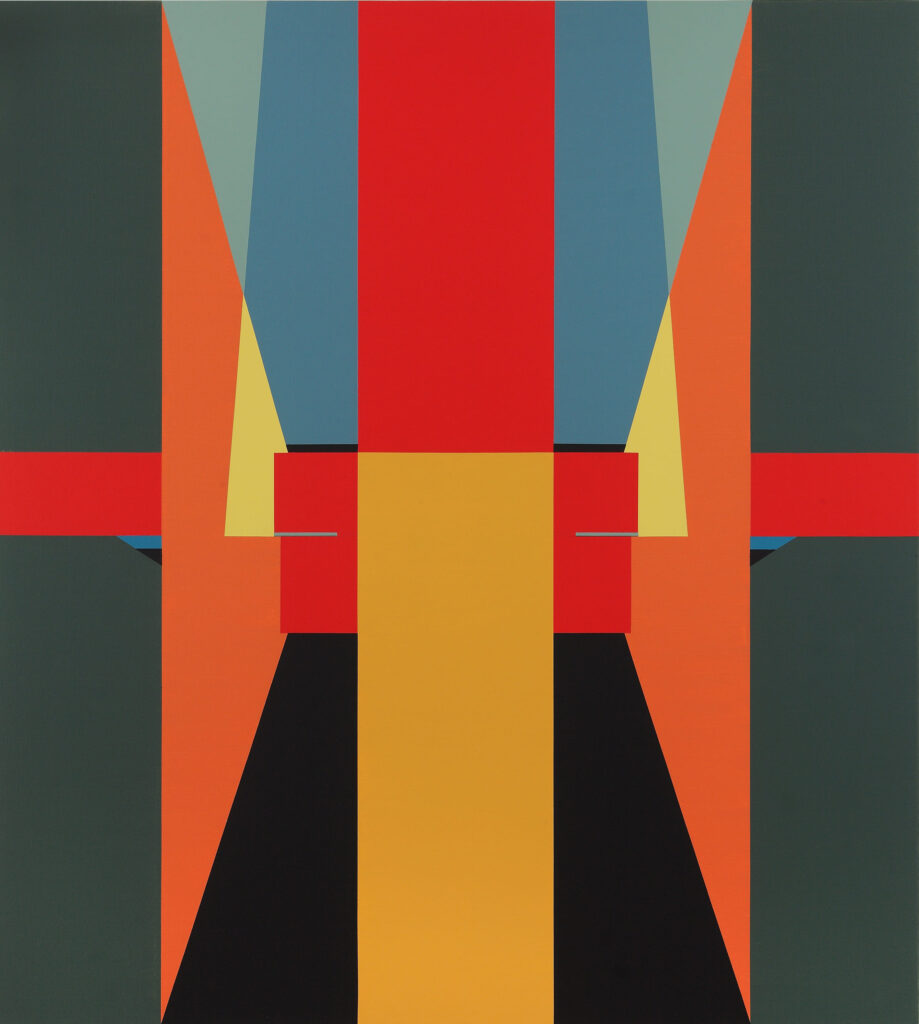
Fanny Sanín [1938, Colombia], Acrylic Nº 3, 2010, 2010, Acrylic on canvas 58 x 52 in.,147.3 x 132.1 cm. © Fanny Sanín. Courtesy of the artist and Sicardi | Ayers | Bacino, Houston
The usual explanations for the phenomenon of informalism in post-war Europe —Angst over the devastation of cities, the horror of massacres, scarcity of food and art materials, uncertainty about the future, repudiation of traditional forms and norms— are not the best description for Sanín’s own circumstances. But were there analogous circumstances in Latin America? In her essay “Fanny Sanin and the pursuit of spiritual harmony” Ana María Reyes points out that “In Colombia, Sanin’s early years transpired during the civil war known as La Violencia (1946-66)”.[4] Similarly, Patterson Sims writes, “The bleak political and social circumstances in Colombia during the mid-to-late 1960s are likewise reflected in both her and Wiedemann’s brooding, darkly abstract expressionist art.”[5] Hence, —although social determinism is questionable— if we assume a modicum of causality between social environment and artistic content, Sanin had good reasons to opt for informalism or gestural abstraction.[6]
Throughout her long and illustrious artistic career Sanin has worked in two types of abstraction: the informalist (or gestural abstraction) one that she started in Colombia (circa 1960) and continued during her stay in Mexico; and the geometric, that she mostly developed in New York, and was mediated by her London sojourn (1966-1969). Sims writes that Sanin “was powerfully drawn to the simplified structure and buoyant color in the hard-edge abstraction of British painters such as Ben Nicholson, Victor Pasmore, Alan Davies and Robyn Denny.” However, her metamorphosis is often credited to a specific event: the Art of the RealUSA 1948-1968 exhibition that Sanín saw in Paris in 1968. Curated by the New York Museum of Modern Art, it featured artists like Clyfford Still, Jackson Pollock and Mark Rothko who might have been congruent with her own modus operandi at the time; and others, like Frank Stella, Ellsworth Kelly and Kenneth Noland, whose works led Sanín towards her own brand of geometric abstraction.
[Oil No 2, 1968]
Works from her pre-geometric period like Oil No 4, 1967 and Oil No 2, 1968 are non-representational and gestural. The surface has textured spots. The materiality of the oil medium is conspicuous even when applied thinly, in which case it is the materiality of the canvas that shows through.[7] To attempt an interpretation of these works is a job for nobler minds. It entails a pictorial algebra where the work X can denote just about anything: the artist’s state of mind, the chaos of the world, etc. Lawrence Rinder, a connoisseur of her work, spells out one interpretation, “While Sanín has said on numerous occasions that her art is non-objective, ‘. . . free of any reference to external reality. . .’, when pressed, she will reveal that there are always two implicit subjects: self and spirit.” On the other hand, Ana María Reyes, sees another exit from the concreteness of her geometric abstraction works: “Sanin’s paintings inspire spiritual and emotional respite during these times of uncertainty, destruction and moral crisis. Her carefully constructed compositions provide a meditative experience, reinforcing the timeless human pursuit of order and harmony.”[8] In sum, from Rinder and Reyes we get the common denominator of both the informalist and geometric abstraction works in that elusive, often ethereal quality called “spiritual.”
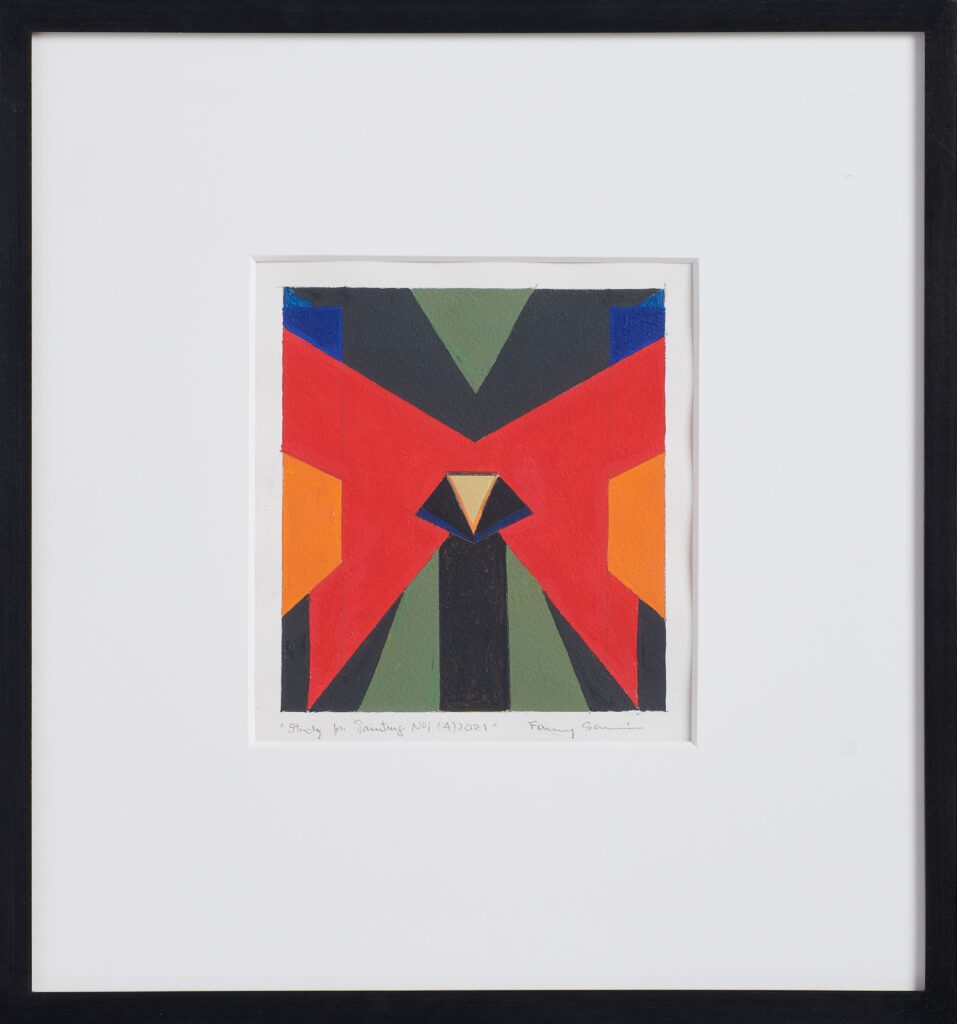
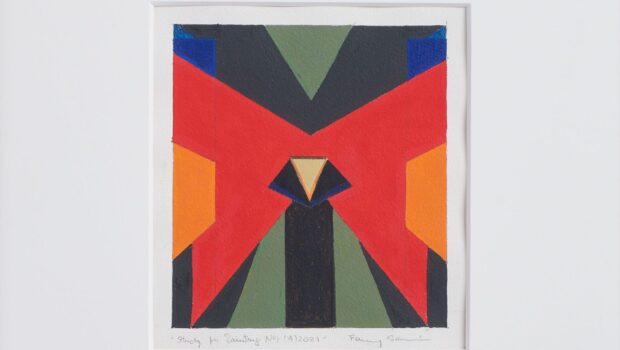
Fanny Sanín [1938, Colombia], Study for painting No 1 (4), 2021, Acrylic on paper, 19 ¼ x 18 1/16 x 1 ½ in., 48.9 x 45.9 x 3.8 cm. © Fanny Sanín. Courtesy of the artist and, Sicardi | Ayers | Bacino, Houston Photo by: Anthony Rathbun
By 1970 Sanin’s geometric abstraction conversion was well under way. Not only the artist but also the viewers were now faced with a whole new set of skills and states of mind for engaging her new works. If her informalist oeuvre asked for introspection and projection, her geometric abstraction required most-of-all, calculus and wonder. Although her first geometric works displayed scintillating colors, as her palette moved farther away from primary and secondary colors, her mature, more symmetric geometric constructions became elaborate, subtle and enigmatic.[9]
[Study for painting #1 (4) 2021]
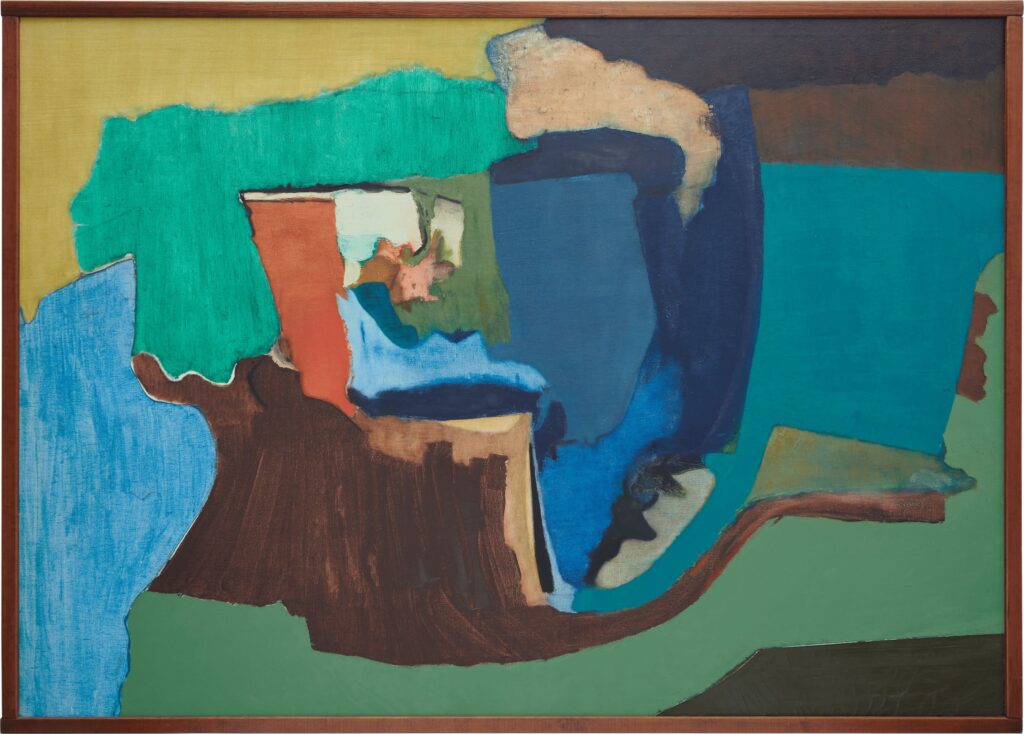
Fanny Sanín [1938, Colombia], Oil No 2, 1968, Oil on canvas, 50 ½ x 70 ⅝ x 1 ¼ in., 128.3 x 179.4 x 3.2 cm. © Fanny Sanín. Courtesy of the artist and, Sicardi | Ayers | Bacino, Houston Photo by: Anthony Rathbun
Perhaps the best way to reflect about Sanin’s work is to consider the method of production in her later period. She starts off by experimenting and designing small-format pencil-colored and acrylic-colored sketches what she will later execute in larger acrylic paintings. Indeed, Sullivan makes the strong claim that “The theoretical and practical basis of Sanin’s work is drawing.” If a viewer would patiently search the book Fanny Sanin: The Concrete Language of Color and Structure he/she would find how colored pencil studies on paper evolve into small acrylic studies on paper, and finally into large acrylic works on canvas many times the original size of the study. The lesson to be inferred is how the myriad geometric structures are conceived as line sketches whose first forms are then filled with the pigment of colored pencils, and their final hue is first adjusted in acrylic at the same small scale, to finally reach its final design and coloration on large canvas.[10] It is a process that leaves little room for emotion and if there is any spiritual dimension, the latter is to be regarded as something closer to some intellectual sense of the German word Geist, rather than something in the jargon of Gurdjieff, Blavatsky, or even Kandinsky.[11]
When asked if she had endured discrimination in the art world for being a woman, Sanín recollects, “I never had problems exhibiting my work in Latin America or even Europe. I exhibited my work during the years I lived in London; one of my works was chosen to be shown at the Festival of Edinburg and they did not care about the gender nor origin of the artist. However, when I arrived in New York I coincided with a historical protest at the doors of MoMA in June of 1970, organized by a feminist group, Women Artists in Revolution (WAR), under the slogan “MoMA: Museum of Men’s Art,” that demanded that 50% of the exhibits included women artists. Women suffered much discrimination. It was rumored that when you left a portfolio in a gallery, whenever the gallerists saw that it bore the name of a woman, they would not even bother seeing it. Many women began to offer their work using male names.”[12]
It is unusual for an art exhibit at Americas Society to be reviewed in the illustrious New Yorkermagazine that educated Manhattanites consult to know what to see, what to read, where to eat, etc. Fanny Sanin’s was, and by none other than Jillian Steinhauer, critic extraordinaire.[13] The flattering remarks of her review read, “All this speaks to Sanín’s masterful ability to create harmony out of tension. Her paintings are a delight to look at, with pleasure arising from the complex interplay of colors—say, black against red against orange—or subtle variations in adjoining geometric shapes. It’s no wonder that Sanín makes many preparatory studies, some of which are on display: her work is exacting. But the feat is that it’s also affective—out of meticulousness she creates an abundance of feeling.”[14] Are we to conclude that Sanin’s punctilious, exacting, cerebral visual calculus, all boils down to feeling and pleasure?
[1] Interview with Ana Vidal Egea for El País (June 4th, 2025). [Translated by the author] https://elpais.com/us/2025-06-04/fanny-sanin-tengo-87-anos-y-sigo-pintando-todos-los-dias-de-nueve-de-la-manana-a-cinco-de-la-tarde.html
[2] Curators, art historians and art critics know all too well the inconvenience (to say the least) of having to write about an untitled work of an artist who has many other such untitled works.
[3] Lecture on Youtube by Patrick Frank “Fanny Sanin & Latin American Abstract Art” (2017). Sanín herself never thought of herself as an informalist artist but neither did most other informalist artists. Nor did the original NY abstract expressionist artists (“The Irascible 18”) think of themselves as such. The exception is the Movimiento informalista de Buenos Aires (1959) who obviously announced themselves as informalist. As for affinities, Tachism (a subset of informalism) is often regarded to be closer to abstract expressionism.
[4] Ana María Reyes’ “Fanny Sanín and the pursuits of spiritual harmony” in Fanny Sanin: Geometric Equations. Americas Society: New York, 2025. Page 44.
[5] Fanny Sanin: The Concrete Language of Color and Structure. Artbook / D.A.P. New York. 2019. Page 63. Different scholars classify Sanin’s early work differently. Sims calls it abstract expressionist. Patrick Frank says it is inaccurate to call it abstract expressionist, and in turn calls it informalist. Sanin herself appears more comfortable and/or used to “gestural abstraction.”
[6] Colombian art historian, Ana Franco, writes, “The main informalists in Colombia, who incorporated collage and assemblage in their paintings, are Alvaro Herrán, Leonel Estrada and Guillermo Wiedemann. There is also Maria Thereza Negreiros. And one could also think the scrap-metal sculpture of Feliza Bursztyn is also part of this context. The ceramicist Beatriz Daza was also considered to be part of informalism; specially, her 1970s assemblages.” (Email: 13 August 2025) [Translated by the author]
[7] In a 2017 lecture (“Fanny Sanin and Latin American Abstract Art”) at the LA Louver Gallery that may be found on YouTube, Patrick Frank states, “Fanny is well within that informalist way of working. The earliest work in this exhibition is in the other room. Oil #4, 1967. What you cannot see is the surface texture of this work, which Fanny achieved through the highly technical bit of cigarette ashes; sprinkling them on the canvas.”
[8] Fanny Sanin: Geometric Equations. Americas Society: New York, 2025. Page 38
[9] Frank wrote the essay “Fanny Sanin’s Audacious Refinement” in which he defends her use of symmetry. It starts, by spelling out the aporia: “Here I will suggest that one of the most obvious characteristics of her paintings— symmetry—provides a profound key to our appreciation of them. My account will rely on recent writings in the relatively new field of neuro-aesthetics, supported by behavioral science and close looking. Symmetry has long been a controversial subject in modern art. George Bernard Shaw stated it bluntly: ‘Symmetry is the enemy of art.'” (Fanny Sanin. LA Louver, Venice, CA: 2017).
[10] “About the studies for my work Acrylic No. 3, 2010, my comment is that I made nine studies for this work, and I have two left which I have reserved for my legacy.” [Fanny Sanin. Email: 18 August 2025]
[11] Most famously, in Wassily Kandinsky’s treatise Concerning the Spiritual in Art (1910), the task of the artist is to find “the principle of the innermost necessity” that he or she can use through expressive means to achieve the goal, “vibration of the human soul.”
[12] Interview with Ana Vidal Egea for El País (June 4th, 2025). [Translated by the author].
[13] Ms. Steinhauer is a winner of a 2023 Rabkin Prize for visual arts journalism and a 2019 Andy Warhol Foundation Arts Writers Grant.
[14] Jillian Steinhauer, “The mesmerizing, hard-edge paintings of Fanny Sanin.” The New Yorker, June 27, 2025
 Fernando Castro es artista, crítico y curador. Estudió filosofía en la Universidad de Rice con una beca Fulbright. Es miembro de la comisión técnica del FotoFest y del consejo consultivo del Center for Photography de Houston. Editor y colaborador de las revistas Aperture Magazine, Art-Nexus, Literal Magaziney Spot.
©Literal Publishing. Our contributors and columnists are solely responsible for the opinions expressed here, which do not necessarily reflect the point of view of this magazine or its editors. However, we do reaffirm and support their right to voice said opinions with full plurality.
Posted: September 8, 2025 at 9:46 pm