
Laughing Matters: Conversation on Humor
Ilan Stavans and Frederick Aldama

Two Academics Walk Into a Bar…
Frederick Aldama: Are you ready to delve into a topic that drove many a thinker to step aside (not serious enough) or to throw up their arms (hard to pin down)?
Ilan Stavans: I can’t think of a more alluring danger.
FA: Why danger?
IS: Didn’t you just caution about the safety hazards ahead? Laughter is lethal. Its capacity to alleviate is as fool-proof as is its ability to destroy. Evil often comes with a smile. Perhaps our reputations will go down the drain as a result of this discussion. But who cares about reputations? They come and go in equal measure.
FA: Beyond dangers and reputations, there is the allure of exploration. We are now beginning to plunge into unknown waters as deeply as we can. I trust we shall learn that no view of human nature can be comprehensive if it omits humor and laughter that are such a fundamental part of our everyday existence. One way or another, in their philosophical systems, thinkers such as Plato, Aristotle, Spinoza, Hobbes, Descartes, Kant, even the grim, pessimistic and rather reactionary, Schopenhauer—have dealt with humor, albeit obliquely.
IS: Not doing so is the equivalent of describing the world in black-and-white. We all moved to Technicolor™ a long time ago.
FA: You’re being cynical, although in good company. Even Thomas Hobbes…
IS: A true cynic who considered us innately and unrelentingly power-hungry: Homo homini lupus or Man is a Wolf to Fellow Man.
FA: Hobbes paused to consider how laughter was, for him anyway, proof that emotions (and he was more wont to focus on the negative ones) were triggered by a physical source and were expressed also physically or bodily. We have here an instance of the claim made by several thinkers that laughter is the material expression of the subjective mood called humor.
IS: Well, the inner world didn’t much interest Hobbes, at least not as a realm of study. In his view, laughter is mechanical. I tend to agree. Have you ever watched the parade of stand-up comedians on Comedy Central? Only rarely are they funny, yet their audience always seems to be in a raucous—on automatic.
FA: On automatic. There’s something in the air today that considers physiology as the source of our emotions. The well-respected Antonio Damasio, picking up on William James, considers that it is the changes in the body that trigger an emotion. So while my mood might be rather neutral, if I physically smile a positive emotion will take over.
IS: One must be careful, though: physiology looks at us as Pavlovian organisms. Yet we have a soul, don’t we? (True, after a hectic day of dealing with colleagues, I feel their soul and mine are figments of my imagination.)
FA: What we are establishing is a relationship between mind and body or an emotional state of mind and a physiological state of the body. Whether we take the Damasio stand that first it is the physiological state then the affective state, or take the opposite position (first the mental mood, then the physiological state), in both cases we are trying to establish a direct connection between the mood of humor and the physiology—the changes in the body. Let’s keep both positions juggled in the air for now. What’s relevant here is the attempt at establishing the relationship between the body and the mind, just expressed in a different way as concerning humor and laughter.
IS: I agree: a gestalt approach.
FA: It could be interesting to explore (in lab conditions, ideally) if it is first a physiological change then the affective change (mirth), but whatever the outcome of this research it will likely tell us nothing about humor as an aesthetic activity and an aesthetic product. Whether the Damasio approach is right or the reverse, we have not yet established in the most precise (and even scientific way) what laughter and humor are. We seem stuck in the unsolvable: ¿Qué es primero, el huevo o la gallina? The old chicken or the egg question.
IS: Humor has to do with attitude, with temper, with disposition. It is also an atmosphere.
FA: Let me get back to your point about automatic laughter. In fact, sometimes we laugh with to a belly-aching degree and we don’t know why. There’s this contagious aspect to laughter. Recall that in 1962 the village of Tanganyika in Tanzania Africa fell into a laughter epidemic. The contagious and epidemic laughter seems to show that at least some varieties of laughter are essentially physiological and reflexive.
IS: True! One can laugh mechanically.
FA: There are many social situations—end of year department parties, for instance—where there is so much fake laughter; I know it’s fake, yet just being around the laughter makes me laugh.
IS: True again! Laughter is contagious.
FA: In other social situations, when and how we laugh—even smile—can be and is socially conditioned. We smile and say hello when greeting people, but the smile coincides with a hello that has no content—no humorous referent. Smiling serves a social function; it’s a social tool used to acknowledge the beginning of a conversation. When we smile in front of the camera, that too lacks a referent. It’s simply by social convention that we smile. And, when politicians smile and chuckle at unfunny jokes this, too, has nothing to do with real mirth felt and experienced by the politician. In this circumstances and others, smiling and laughing function referent-less social indicators.
There is no specific content to laughter or smiling or any other physical and physiological and reflex external manifestation of mirth because there can be and is many thousands of examples of laughter and smiling that do not elicit mirth.
IS: The way we´re meditating on humor reminds me of what Winston Churchill said on a radio broadcast in 1939 about Stalin’s Russia, at the dawn of World War II: “I cannot forecast you the action of Russia. It is a riddle, wrapped in a mystery, inside an enigma.” Then Churchill added: “But perhaps there is a key.”
FA: It could be that when we hear canned laughter we might feel rude not to laugh—even if watching a bad comic on Comedy Central; the same when in a room at a departmental party—if I don’t laugh, I’m considered an outsider. (It’s the same impulse I have when I smile shaking someone’s hand. I don’t want to offend them by not smiling.) One of the reasons why I laugh when I hear canned laughter is not contagion, but social convention. I laugh because I don’t want to be rude. Sometimes I don’t even hear a joke properly, but I laugh so as not to appear as an outsider.
IS: Laughter ignited through social pressure—and not social pleasure.
FA: Perhaps it can be our pleasure to keep in mind throughout our conversation several main sources of laugher: Laughter triggered by humor. Laughter as a reflex as with the social conventions (a way of relating to others) mentioned above. Laughter as a physiological reaction concerning contagious laughter.
IS: Each of them is propelled by a different cause.
FA: Let’s sit for a spell with philosophers who have thought about humor and laughter. When Hobbes and Schopenhauer talk of laughter it is ultimately connected one way or another with a laughing at someone; it arises as an expression of a feeling of superiority. They both see humor and laughter mainly in terms of human conflict. Theirs is essentially a one-sided view. They identify only one of the many psychological and social functions of laughter, don’t you think?
IS: They couldn’t avoid it: one was a Briton who championed absolutism, the other a German who trusted that to live alone was the fate of great souls. Schopenhauer was convinced that truth goes through three stages to be accepted: first it is ridiculed, second it is opposed, and third it is considered self-evident. In and of itself, that process, in my eyes, is funny. Can’t we simply take the easier, faster route, and make all ridiculous things self-evident?
FA: Humans seldom take the easier, faster route, Ilan. Schopenhauer is best known for his doom-gloom worldview—a sensibility seemingly devoid of laughter. However, he did articulate an important, even if somewhat minor, theory of laughter. When he was a young man, he wrote Book I of The World as Will and Representation (1819). He was so sure of himself that upon its publication he was sure that his fame would reach far and wide. When he was finally allowed to teach at the university (as a non-salaried professor) Schopenhauer deliberately scheduled his classes at the same time as Hegel with the idea that his popularity would drain away Hegel’s students. He had little joy for Hegel. Of course, he could not have been more deluded. He was no worthy rival to Hegel. Nobody was interested in what the young Schopenhauer had to say.
When Schopenhauer was much older he did begin to attract a certain amount of attention. Some students and rather unimportant philosophers along with regular folks would visit him. And, during these twilight years he did attain a certain popularity, mainly among critics in the literary and arts world. They liked that a philosopher had written niceties concerning the arts and literature. However, in the philosophical world he was largely despised. His ideas were ridiculed and considered ridiculous. When philosophy was turning more toward the use of science and Schopenhauer was leaning more toward the mystical (the substance of the universe identified as an ethereal substance called will). His importation of mystical concepts from India, Indeed he young Schopenhauer was cut from the Orientalist mold of his day.
IS: Schopenhauer, and his brainchild Ralph Waldo Emerson, aren’t taken seriously as thinkers because unfortunately we’ve moved away from the belief that things are eternal.
FA: All this said, I wonder if there might be something useful to excavate from Schopenhauer’s Book I where he begins to describe laughter as arising from the sudden apprehension or perception of some kind of incongruity between the material manifestation of a phenomenon and its abstract representation (a thing, a person, an action). Two logics come into collision: that of actuality and that of concepts. And laughter results from this clash. Schopenhauer’s focus is on intentional laughter as well as mentalistic laughter, which results in the tension between the direct intuitive perception of concrete objects and the abstract conception of universal concepts.
IS: Schopenhauer believed that Plato’s theory of the universals and the particulars made room for… well, a degree of ineptness. For instance, when we perceive a chair, there is a tension between that individual object and the archetype of a chair we have stored in our mind. The discrepancy between them—a chair with a toupee, a chair in the form of a nail-cutter—generates laughter in us.
This theory, useful as it is, only takes us so far, for much of humor emerges not from incongruity but from irony, exaggeration, and double meaning, among other things.
FA: John Morreall’s “Philosophy of Humor,” in the Stanford Encyclopedia of Philosophy, mentions several categories of humor, including the “superiority theory” (Hobbes), relief theory (Freud’s hydraulic architecture), and “incongruity theory” (as you just mentioned). However, none of these theories cover the territory—and not by any stretch. There are elements that refer to superiority, relief, and incongruity. But I think we have to work toward a more unified sense of theory.
I think that Peter McGraw with his “Humor Research Lab” is getting closer to formulating a more unified theory. He does this by more systematically separating laughter from humor.
IS: I’m a skeptic, Fede. After countless conversations among us, you obviously know it. Formulating a theory of humor, one that separates laughter from humor, is an intellectual endeavor unlikely to make us understand fully why something is funny. The reason, in my opinion, is that laughter has much to do with spontaneity. You might argue that such statement, in and of itself, is already a theory. But so what? Does it make laughter more scientific?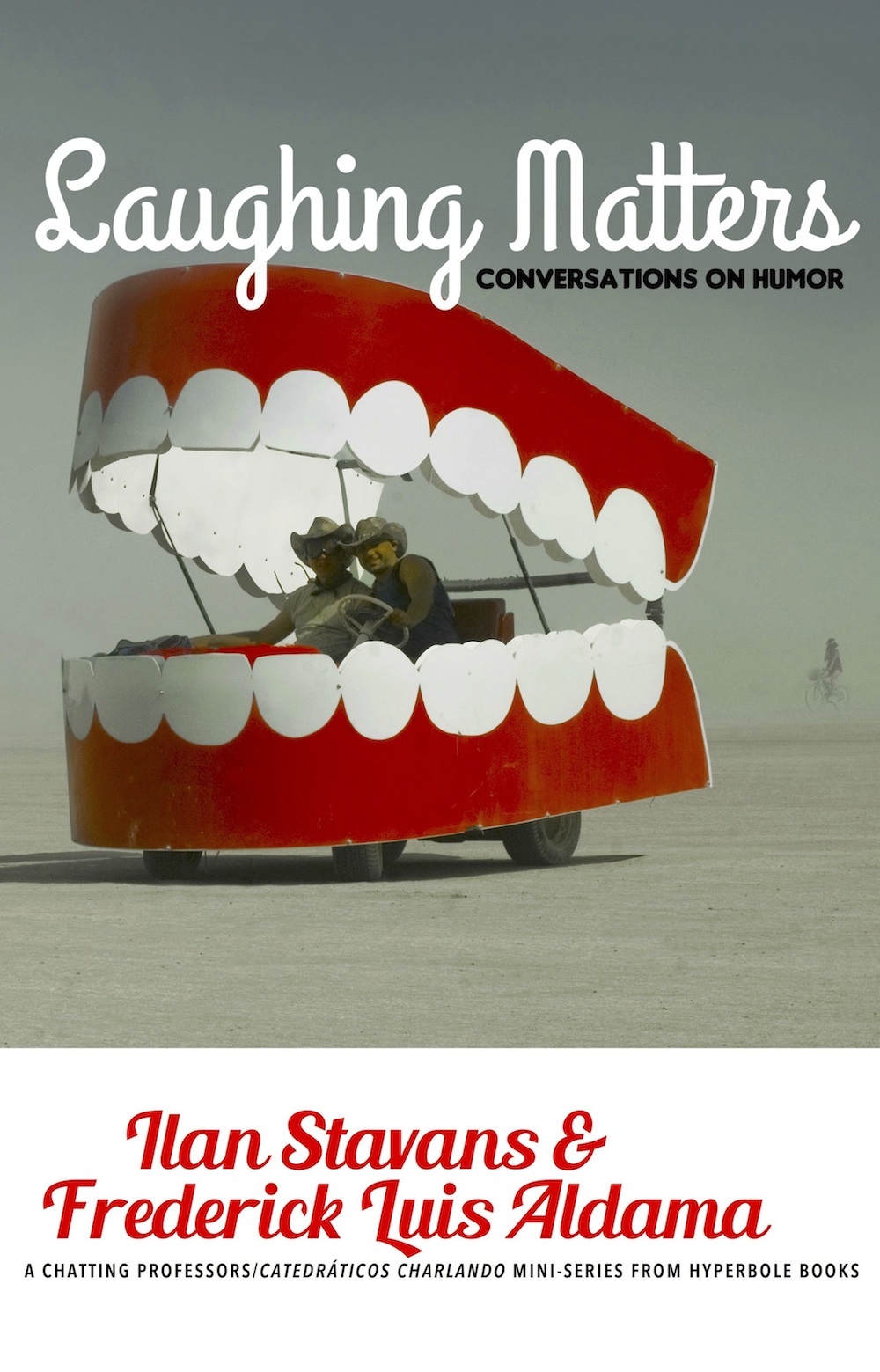
FA: Another way we might approach the topic of laughter and humor might be to ask: what brings tragedy into being? What makes tragedy emerge? What makes the tragi-comedy emerge? It’s a question that doesn’t have an answer. If we had an answer for these questions, then we could have formulas. To produce a tragedy you have to follow A, B, C, D and result will be a tragedy. In the form of a novel, have to have Y and Z.
What are the springs of humor? Why does Rabelais’s humor differ from Woody Allen’s humor (his books, not films)? In what way do they differ? We can find them funny in both cases and consider them both successful examples of art devoted to the creation of humor. However, there are no formulas in art. We can learn to paint by imitating others, following certain rules (to move geometrical figures in specific ways to create optical illusion of 3D, for instance), but all this will not bring about Harlequins by Picasso. If there were a formula—if we could reduce an aesthetic activity to an algorithm—then perhaps we would have as clearer an answer to this idea that humor emerges from irony, exaggeration, and etc.
IS: No formula, please.
FA: Long before Hobbes and Schopenhauer, of course, we already have a tradition of intellectuals who considered laughter to be no laughing matter. Plato disapproved of loud laughs, judging them vulgar, and would say that what some people considered funny is a tragedy for others. Aristotle, too, saw vulgarity and lack of taste in people acting as buffoons, and thought laughter was appropriate only when it did not cause pain or harm to others. Cicero considered laughter as arising from “some kind of meanness and deformity.’’ And Spinoza made the point that ‘‘a man hates what he laughs at.” Kant saw in laughter a forced act of expiring ending in nothing. Charles Baudelaire considered laughter “satanic” and as a sign of “fallen humanity.”
IS: Therein the reason why I used the word danger. Fidel Castro never likes jokes about Communists. His answer to them wasn’t laughter but guess what? The dungeon for the joker. And talking about the joker, or better, The Joker, is there more frightening character than Heath Ledger’s The Joker in The Dark Knight (2008), part of the Batman trilogy? He is cruel, mean-spirited, and a clown. Of course, one might argue that all clowns are cruel and mean-spirited.
FA: That clowns are cruel, very much in line with Plato and Aristotle, is an important insight. We have to keep clearly in mind the distinction between humor and laughter, so as not to play hopscotch between the two without a sense of what we are jumping to and from.
There are millions of phenomena that can be considered causes of humor. I find rather half-appetizing the incongruity, superiority, and relief theories as possible conceptual models for capturing all these phenomena. They just don’t cover the myriad of situations where humor emerges.
This doesn’t mean that we cannot formulate a theory. To do so we have to make a clear distinction between humor and laughter. Let me clarify by example. I’m not sure that all clowns are cruel, but it is the case that in slapstick often we see a clown tripping on bucket, or kicking another clown, etc. and so yes they do seem to be eliciting laughter through cruel actions. They do elicit laughter—and even more frequently in children than adults. I ask, however, what is the difference between a clown’s slapstick skit and a Tex-Avery cartoon (the Droopy and Screwy Squirrel are my favorites) where we laugh at episodes filled with cruel acts? We laugh (we can laugh) because in both instances what is presented is a benign violation. That is, the clown and the cartoon violate the rules of social decorum (good taste and behavior, say) as well as those of physics and biology in a benign way. The cruelty is not real. The entity (animal or person) that slips, run over, or even blown up is neither hurt nor destroyed. The real circus clown or the animated cartoon elicit laughter because all their violations take place in a safe space.
That is, while some clowns might be cruel and others not, what we’re talking about is humor and then laughter in its relation to humor; certainly clowns are very efficient in their conveying of these benign departures of the normal (socio-ethical, physical, biological) universe.
IS: Did you hear the news? Clowns are about to become an extinct species. Few people are opting for a career as clowns. I wonder why. Has the media usurped the space they used to inhabit?
FA: Yes, clowns and even circuses as a whole are going the way of the dodo bird. I don’t know if it is because of the media and its omnipresence in society. Undoubtedly, however, it’s a question worth studying more deeply. But, to go back to philosophers take on the subject, one who is famous for splitting mind from body with his cogito ergo sum (I can doubt existence, but not doubt that I’m the one doubting) is Descartes who also reflected on laughter. For Descartes, there is joy that springs from what is good and serious and laughter that comes from evil.
IS: Laughter comes from God, too. What about the cliché “laughter heals”?
FA: More than a cliché, it’s a huge industry, right? Just a quick search on the Internet and we see how many thousands of people advertise how laughter heals, extends life expectancy, even cures cancer. Even when grieving the death of a pet or a relative, people tend to tell us to shake it off and to look at the bright side etc.; often, they’ll crack a joke to try to cheer us up when all we want to do is mourn. The laughter industry has taken away our right to respond naturally to loss.
IS: Indeed, the laughing industry has taken away the pleasure to laugh simply, incumbently, to laugh as a simple pleasure.
FA: Darwin identified laughter in certain non-human mammals, such as chimps. But when laughing we emit the air from the lungs in a single action, always expelling and never inhaling during the act, whereas chimps breath in and breath out four times in each laugh. Thus a chimp’s laugh sounds very different from human laugh because it follows a different pattern: it is a quadruple ah made while breathing out and in. As you can see, we are dealing with a parade of views on laughter.
IS: We’re yet to reach the topic of theories of humor.
FA: Actually, I think we’ve been talking about it all along. It’s just that it hasn’t been systematically identified as different from laughter. There are the main theories identified by Morreall. We should add to it the theory formulated by Peter McGraw, where humor occurs when a person simultaneously appraises a situation as a violation and yet believes it to be okay or acceptable.
IS: The comfort of discomfort, or vice versa. That’s funny!
FA: Another rather serious and ornery fellow is the proto-existentialist Søren Kierkegaard, who turned his rather hefty dissertation, submitted in 1841, into the book, On the Concept of Irony with Continual Reference to Socrates. While for Kierkegaard the attainment of a state of pure irony is impossible and its pursuit self-destructive, he did consider that used playfully as a sort of game could lead to a source of entertainment to guard against the social pressures of conformity. Complex laughter—and not slapstick or silly guffaws—could expose the cracks in the façade of the status quo. (It’s worth nothing, too, that he used the pseudonym “Johannes Climacus” in the writing of the first volume of the philosophically weighty Concluding Unscientific Postscript [1846]. Climacus is identified as a “humorist.”) Of course, the biggest irony here is that this thinker who didn’t express or feel much joy and who found it difficult to laugh, started his career with this book length discussion on the concepts of irony, humor, and laughter.
IS: I love this Kierkegaard reference. Philosophers are almost always painfully serious and Kierkegaard is the perfect example. Of course, it isn’t difficult to ridicule them. To write about irony and not attempt an ironic twist is like organizing a marathon but resisting to run in it. Who is it that said that to know is to experience? Of course, not all knowledge comes from experience. Otherwise, how to explain our knowledge of dinosaurs?
FA: You mentioned earlier that laughter comes from God. Certainly, the most godlike figure we can imagine is the artist. That is, the creator (in the strong sense of the word) of worlds: dance, architecture, literature, and art. The products of this creative activity are always something new—something that was not present in the world before it was created. Yet we have knowledge of these products of creation—just as we have knowledge of dinosaurs, or planets and galaxies that we don’t know by direct experience. Indeed, Bertrand Russell conveniently made the distinction between knowledge in general and knowledge by experience, or what he called, by knowledge acquaintance; we have much more general knowledge, say, than by knowledge by acquaintance.
I’ve never been to García Márquez’s Macondo yet I know it the way he wrote about it; what I know about France of Rabelais’s Gargantua and Pantagruel is what he invented of France and the mirthful adventures of Pantagruel’s testing of his learned knowledge against material reality. I don’t know giants, even, like Gargantua and Pantagruel nor do I know any human who can flood the streets of Paris with their pee, yet I know well these two giants because the godlike creator Rabelais is telling me how they act—and in this telling Rabelais makes me variously smile, giggle, and uproariously laugh. I appreciate very much his humor in creating the giants and their behavior and the world they live in.
IS: General knowledge is what enables us to have shared experiences.
FA: Through the concept “the will to power,” Nietzsche claims “man alone suffers so excruciatingly in the world that he was compelled to invent laughter.”
IS: In my youth—and excuse the redundancy—I used to think of Nietzsche as a thinker. Now I think of him as a poet. For some reason, this brings me to two thinkers you haven’t mention mentioned who spent considerable time reflecting—that is, not summarily dismissing—humor: Henri Bergson and Sigmund Freud.
FA: Yes, Bergson (directly) and Freud (by way of his hydraulic formulations of the psyche) tackle the subject head on.
IS: I like the image: head on…
FA: Head on, but with the safety of a crash helmet. Bergson considered le comique de caractère as driven by absurdity and contradictions. And for Freud we laugh hardest at humor based on impulses such as sex and aggression, an indication of the id erupting and breaking through the dam set up by the ego.
IS: Neither of their theories is particularly comic. Freud’s strikes me as astonishingly mechanical (again, the image of automatons). And while I find Bergson’s infuriatingly obtuse, I welcome his willingness to formulate a comprehensive appreciation. Ironically, the figure who may have had the biggest influence on humor or comedy in the arts is the thinker whose work disappeared in the passage of deep telescopic time: Aristotle’s second book of the Poetics that dealt with comedy wholly is only phantasmagorically present. We know about it from references but the work itself has disappeared, which means we’re left in the dark as to its content. Umberto Eco built the premise of his novel The Name of the Rose (1980) around Aristotle’s absent book. (He seasoned the plot with a character that looks like Borges—a funny image since Borges was blind. In my opinion, Borges is among the funniest writers.)
FA: You refer to Eco’s inventing of the blind library keeper Jorge de Burgos whose name alludes directly to Jorge Luis Borges. “Laughter is a devilish wind which deforms us,” de Burgos exclaims at one point. He keeps us from knowing this second, most dangerous book by Aristotle. The dangers of humor and laughter.
IS: That book, in Eco’s imagination, is poisonous.
FA: The free-flowing conversations in this volume—this one setting the context, the second on Aristotle and the art of ridicule in popular culture, the third on freedom in Cervantes and Shakespeare, the fourth on ethnic humor, and a concluding one the limits of humor—explore humor from multiple perspectives.
IS: I love the genre of the conversation. It is astonishingly liberating. Focus is crucial, of course, but one doesn’t need to be constrained to a singular topic. Or better, one is able to rotate around a topic without feeling constrained by a straitjacket.
FA: I’ve started with laughter because it can shake us out of our habituated sense of the world and its objects, opening us, to experience the sublime in nature and aesthetics, but it can and does also work to comfort, reassure, and stabilize. To pick up from the title to this introduction, if we look around the hallways of the academy today we can assume that these two academics at a bar are likely to talk with great gravitas and purpose about countless topics. What they aren’t doing is joking around, laughing jovially.
IS: The archetype of the academic is pathetic. Is there a way to debunk it?
FA: The stereotype of the academic is so deeply etched into popular culture I’m not sure we can debunk it—maybe unsettle it, no? The image: bottle-thick glasses, brown corduroy, arm-patched jackets, and with permanent bedhead have all become stand-ins for absent-mindedness. Watch any show on TV or run down the list of films that feature academics, and we are seemingly a very serious lot. Michael Douglas plays the has-been creative writing Professor Grady Tripp (Wonder Boys [2000]); Robin Williams as the Whitman-inspired John Keating (Dead Poet’s Society [1989]) who breaks the rules so the prep-school teens can carpe diem. When the adventuring Indiana Jones (Harrison Ford) steps into his seminar on archeology, he becomes the bumbling Dr. Henry Walton. Even the more hip academic, Professor Jennings (Donald Sutherland) maintains a staid manner within the topsy-turvy world of Animal House (1978).
Maybe there’s something to these stereotypes? In other words, there is laughter in the media’s representation of academics, but it doesn’t erupt from two academics (at a bar or otherwise) sharing a joke, but rather in the film-going audience. The overly serious, shambling academic is the butt of the joke.
IS: Oy gevalt! Yes, academics aren’t supposed to laugh, let alone be funny. As you say, they are frequently laughed at.
FA: The gravitas and solemnity of academia goes back to the Middle Ages when the first universities were established in European cities such as Paris. Academic life was very harsh, disciplined, and a serious matter. But at the same time, just as society at large was submitted to a great deal of oppression by all the feudal and religious institutions, periodically regular everyday folks were allowed to break the rules and go into Animal House like orgies of derision and laughter; we know this most typically as in the form of the carnival when the figure of the king was crowned as the fool, and etc.
In hallowed halls of learning, students were also periodically allowed to make fun of academia. This is when we had, for instance, these Goliard songs sung by Clerical students objecting to the contradictions in the church, to financial abuses, exploitations, and the even more taboo subject of sex. They established the tradition of singing these Goliards walking down the streets, and making fun of academia in general. They were, of course, the inspiration to Carl Orff’s Carmina Burana (1935-36). Perhaps also the inspiration to Animal House (1978) and Phillip Roth’s novel, Indignation (2008). The academic as serious runs deep in our representational history. In art history, we have all those images of robed, white-bearded, solemn men pacing with scrolls and tablets.
IS: Stuffy know-it-alls!
FA: To talk about humor and academics in the same phrase is thus an oxymoron, don’t you think?
IS: An Oxy moron—that’s what the chapter’s title should be: two Oxy morons walk into a bar.
FA: Yet, we know that at least some academics and intellectuals of yesteryear had fun playing with their ideas alone and with others.
IS: Stereotypes, by definition, are empty carcasses.
FA: Was there a Halcyon moment in the history of the academy when we could and did smile, laugh, and poke fun?
IS: If so, I slept through it. I can’t remember ever hearing about it in class.
FA: My sense: what I hear in the university hallways is the somber tone of tolling voices and not laughter. Have we lost (if we ever had?) the capacity and freedom to relish in our work as teachers—and our students as learners? When did we begin to take ourselves so seriously, Ilan?
IS: I too have the opinion that academics are boring stuck-ups. Yet I resist such self-portrait. I find myself laughing frequently, laughing joyfully. In fact, the term academic, in my own lexicon, is derogatory.
FA: In Why the Humanities Matter (2008), I focus on the period when deconstruction (and post-structuralist theory more generally) made the trans-Atlantic crossing. That is when scholars attached themselves to a philosophical idealism by taking up the task of hypostasizing reality. It’s a moment when seriousness seemed to pervade the hallowed halls of the academy like an epidemic.
IS: The moment in which everything became relative. Is there something funnier than that? Nothing is sacred any more. Doubt reigns uncontested. Everything is laughable…
FA: Of course, the serious turn is not only a philosophical orientation. It might also come with our increased anxiety as professors that we must publish or perish. And let’s face it, publishing on the subject of humor doesn’t tip the balance the way publishing does with more weighty matters like trauma, pain, grief… and death. An article on Chaplin, Cantinflas, or Los Bros Hernandez doesn’t hold the attention of a random colleague in the same way one on the sinister master narratives of modernity does.
IS: I don’t believe you’re right. The arrival of relativism erased the border between highbrow and popular culture. These days nothing is serious because everything is. Think of the way we digest the news, through The Daily Show and The Colbert Report. Topics of life and death are brought to us by comedians.
FA: I agree. What makes this worse is that even presidents present policies in shows such as those of Jay Leno and others before they are presented formally through official channels such as congress. The highest authorities in a given nation become themselves clowns. The entertainment media turns political policies into a circus. In “La viuda Ching, pirata” (1935), Jorge Luis Borges reminds us that in Greek teoría means festival or procession.
IS: The life of the mind is as exciting as it is ridiculous. We spend our lives eating our nails. No doubt the world needs carpenters, plumbers, lawyers, diplomats, even pirates, but—please!—not academics.
FA: This is not only the prejudice of those in the academy. I mention my work on Latino comic books to a neighbor who is a dentist and to other unsuspecting folks and they give me the you-can’t-be-serious look. It’s already bad enough that they think the humanities are frivolous. When I add that I’m interested in playful fictions, they consider this an interest and activity completely removed from real work and the real concerns of everyday reality.
IS: Would it be the equivalent of asking the dentist if he ever eats candy?
FA: Nicely put, Ilan. Of course, this isn’t to say that scholarship on laughter in the humanities is nil. A quick run of the MLA International Bibliography database says there are 974 entries (books, articles, dissertations, and other peer reviewed pieces) with laughter in the title. Usually, however, this is qualified by “resistance,” “subversion,” “emancipate,” “decenter,” and tied to some identification of an ideological position and sociopolitical identity.
IS: None of those qualifiers is funny. After listening to the list of titles, I feel like yawning.
FA: At one point in the mid-1990s, Dennis Dutton turned this seriousness as expressed in the overly mannered, jargon-full, clunky polysyllabics (“decenterize,” “hybridize,” “victimize,” “denationalize,” “performativize”) into “The Bad Writing Contest” (1995-1998) that awarded (unofficially, of course) prizes for worst scholarly writing. One such prize went to Judith Butler for the following sentence: “The move from a structuralist account in which capital is understood to structure social relations in relatively homologous ways to a view of hegemony in which power relations are subject to repetition, convergence, and rearticulation brought the question of temporality into the thinking of structure, and marked a shift from a form of Althusserian theory that takes structural totalities as theoretical objects to one in which the insights into the contingent possibility of structure inaugurate a renewed conception of hegemony as bound up with the contingent sites and strategies of the rearticulation of power.”
IS: Now there’s a mouthful for the brain to chew on. She’s truly awful! But the company she keeps is plentiful.
FA: I laugh heartily—not the intended reaction, I suspect.
IS: Two academics walk into a bar. The bartender says, “Is this some kind of joke?”
*Excerpt from Laughing Matters: Conversations on Humor, by Ilan Stavans and Frederick Aldama (Hyperbole Books, 2016).
Posted: March 17, 2016 at 9:32 pm