
Arrhythmias
Greg Walklin

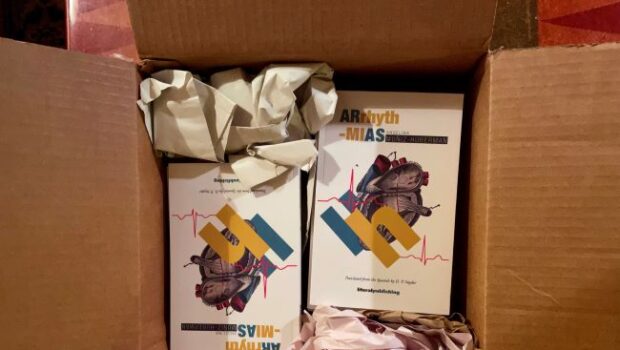
* Arrhythmias by Angelina Muñiz-Huberman. Translated by D. P. Snyder (Literal Publishing/Hablemos escritoras, 2022)
At the end of Arrhythmias, Angelina Muñiz-Huberman’s collection of 32 short essays and imaginative pieces, she makes her intentions plain. “I have written the strangest book,” she says. “Which is nothing. Nor anyone. Nothing. But necessary.” It is a “naked book,” she continues, a “mirror book,” and a “wish book,” a “book of twisted lines” and “a God-less book.” These are certainly all true—this is a book of multitudes, reflections on various aspects of history, both strikingly personal and clinically political, all united by metaphorical variations of “extrasystolic sinus arrhythmia,” a heart condition that Muñiz-Huberman herself has.
Intentionally, thus, irregular in its pacing, Arrhythmias features some longer pieces, some shorter ones, some very short ones, with the personal and the political veering and twining throughout. This exerts centripetal and centrifugal forces, pulling the readers into the world of the author, right before sending them back out again to see the injustices of the planet. Just after we find out some of Muñiz-Huberman’s deeply personal history, for example, we are sent out for literary criticism, or to imagine the life of a war photographer, or to hear about a historical tragedy of the 20th Century (“[t]he century of the cruelest wars and the most pitiless exiles”). Her own personal life receives nearly as many pages as Walter Benjamin’s, for example. Venturing, in the way she does, back and forth between the self and big historical topics, recalls the origins of the essay; no doubt that Muñiz-Huberman, a professor of Medieval Literature and Comparative Literature at Universidad Nacional Autónoma de México, is extremely familiar with Montaigne, whose essays exert an obvious influence on the form and format of Arrhythmias.
Like Montaigne, Muñiz-Huberman was born in France; her parents, though, had fled Spain during the Spanish Civil War. After a stop in Cuba, the family settled in Mexico City during World War II. She threads this personal history throughout Arrhythmias, both at micro and macro levels. In “Father, (Absent) Mother, and Daughter,” a seemingly biographical piece written in a cold, reportorial tone, with a distanced third-person POV, where Muñiz-Huberman describes an abusive father and a mother who was never around at the right time to prevent the abuse from happening:
It was happening or nothing was happening. The girl did not know. Twelve years old. All alone. With her father. She never remembered it. She never knew if it had happened or not. What was supposed to happen? Nothing. Or everything. All alone. And her mother? Not there, on purpose or by accident. She was twelve years old and already she had a long history to remember.
The chief success of this piece is the way the pain’s severity increases with the distance this writing puts between the trauma and the point of view. “The more acute the experience,” Harold Pinter was to have remarked, “the less articulate its expression.” While this is undoubtedly true, nevertheless this essay—and really this entire book–manages to be quite articulate in working through the past. (“Memory,” another piece drolly proclaims, “that prison sentence.”) Muñiz-Huberman is equally affecting even when describing trauma happening to others, such as the many crimes perpetrated against the Jewish people in the 20th Century, or any of its individual victims.
Among these victims is Walter Benjamin. A frequent subject of study for his ahead-of-his-time literary thoughts, and tragic demise, the famous peripatetic appears in several pieces here, including “Wanderer,” “Angelus Novus,” and “Places and Castles.” Benjamin, Muñiz-Huberman writes in one of the pieces, had really been an “esperando,” “waiting and hoping all his life, his whole entire life.” Esperandos, a footnote explains, was a name given to 17th Century Portuguese Crypto Jews “because they were waiting for the Messiah.” Of course Spanish, “esperar” the verb can mean both “to wait” and “to hope”; and it is Benjamin’s unique tragedy that he died, essentially, waiting after having lost hope of escape.
Other memorable pieces include one on Gerda Taro, the pioneering German Jewish war photographer who covered the Spanish Civil War, and her partner, Endre Friedmann (alias Robert Capo). “No matter how often [Capo] turns to the visible image,” Muñiz-Huberman writes, “it is the unimaginable that he truly seeks.” “Stange Trialogue” is an imagined conversation among Hannah Arendt, Simone Weil, and Maria Zambrano—it plumbs many deep questions of Jewish identity, including guilt, perhaps no more acutely than in Arendt’s complicated, and infamous, relationship with Heidegger.
In another strong essay, Muñiz-Huberman describes W.G. Sebald—to whom the guilt of the Holocaust was an event of central purpose—with, it almost feels like, a personally familiar manner: “He wrote because he could not do otherwise. It was his way of being.” Sebald’s writing was “a kind of diminished waterfall of restrained impulse and ceaseless observation.” His unexpected death—a heart attack while driving, causing a car crash—was “the exact measure of his life. It jointed loose ends without making a shred of sense…” Sebald’s influence can be felt in “Ship to Nowhere,” about a ship of refugee Jews fleeing Europe, only to be sent back by the United States, which is the kind of horrific event plumbed by Sebald’s novels. (Sebald himself also wrote a fine essay on Walter Benjamin in “A Place in the Country.”)
“Retold Tales,” one of the more affecting bits of memoir here, is likely to still linger with this reviewer for quite some time. It features an art dealer who falls in love, essentially, with a young couple. This love is doomed from the start, of course. Muñiz-Huberman both evokes the sadness of the story but also the way certain “retold” stories wind their way to new listeners:
You pay close attention to them because it is the first time you are hearing them, and they grab you. Then you store them away in some drawer of your memory bureau. Then you tell the story to someone else, performing it and adding a little salt and pepper.
The pleasure in reading this book comes from both its “salt and pepper” variations—the many topics, styles, approaches, and ideas covered here, with the twists that Muñiz-Huberman provides—and the singular, consistent way it chops them up into digestible, short repast. (“As if the world were a breathing exercise.”) Muñiz-Huberman’s writing, rendered into crisp English by D.P. Snyder, is precise and lucid, clear of foggy abstractions. As a piano player, Muñiz-Huberman writes that she “turned legatos into staccatos.” Even if the music starts and stops, you will surely want to keep listening.
*Image by D. P. Snyder
 Greg Walklin is an attorney and writer living in Lincoln, Nebraska. His book reviews have appeared in The Millions, Necessary Fiction, The Colorado Review, and the Lincoln Journal-Star, among other publications. He has also published several pieces of short fiction. Twitter: @gwalklin
©Literal Publishing. Queda prohibida la reproducción total o parcial de esta publicación. Toda forma de utilización no autorizada será perseguida con lo establecido en la ley federal del derecho de autor.
Las opiniones expresadas por nuestros colaboradores y columnistas son responsabilidad de sus autores y no reflejan necesariamente los puntos de vista de esta revista ni de sus editores, aunque sí refrendamos y respaldamos su derecho a expresarlas en toda su pluralidad. / Our contributors and columnists are solely responsible for the opinions expressed here, which do not necessarily reflect the point of view of this magazine or its editors. However, we do reaffirm and support their right to voice said opinions with full plurality.
Posted: January 19, 2023 at 8:21 pm